Stop Begging the School for Help. Start Enforcing Your Child's Educational Rights in Manitoba.
The school called you at 11:00 AM. Your child is being placed on a "partial day" schedule — two hours in the morning, then home. They said it was a "safety decision" and there "simply aren't enough Educational Assistants." They told you this was temporary. That was three weeks ago. Your child now spends five hours a day at home while you scramble to keep your job. You asked the principal when full days would resume. She said she "couldn't make any promises."
You tried the collaborative approach. You attended every SSP meeting with a positive attitude. You brought cookies. You thanked the teachers. You trusted the "Student Support Team" to act in your child's best interest. And slowly, quietly, the supports that were documented in the Student Specific Plan stopped showing up. The EA hours shrank. The speech therapy went from weekly to "as available." The school kept saying "we're doing everything we can" — and you kept leaving meetings with nothing in writing.
Here is what the school does not want you to know: "We don't have the budget" is not a legal defence in Manitoba. Under the Manitoba Human Rights Code, every school division has a duty to accommodate your child's disability to the point of "undue hardship" — and undue hardship is an exceptionally high bar. Budget constraints and staffing decisions within a division's internal allocation do not meet it. When a school cuts your child's EA hours and calls it a "resource distribution decision," they are making a human rights argument they would lose.
The Manitoba Special Ed Advocacy Playbook is the Dispute Resolution Arsenal — the tactical toolkit that translates Regulation 155/2005, the Public Schools Act, the Canadian Charter of Rights and Freedoms, and the Manitoba Human Rights Code into the exact letter templates, escalation strategies, and legal citations you need to force your child's school to deliver the services it promised. This is not an American guide. There are no 504 Plans, no IDEA references, no FAPE. Every template, every script, every escalation path is built exclusively for Manitoba's provincial system.
What's Inside the Playbook
8 Fill-in-the-Blank Dispute Letter Templates
Every letter cites the specific Manitoba regulation that triggers the school's legal obligation. Challenge SSP non-compliance when the accommodations on paper aren't showing up in the classroom. Demand restoration of full-day programming when the school sends your child home and calls it an "accommodation." Escalate EA hour reductions with a letter that references Regulation 155/2005 and the duty to accommodate under the Manitoba Human Rights Code. Request a formal psychoeducational assessment. Escalate to the Student Services Administrator when the principal won't act. File a complaint with the Board of Trustees. Initiate a formal review through Manitoba Education. File with the Manitoba Human Rights Commission when the core issue is discrimination. These aren't generic form letters downloaded from an American website — they are Manitoba enforcement tools that create a documented paper trail the moment you hit send.
The Manitoba Escalation Roadmap
When informal conversations fail — and they will, because informal conversations don't create legal obligations — you need to know exactly who to contact next and in what order. The Playbook maps the complete chain of command: classroom teacher to resource teacher to principal to the divisional Student Services Administrator (SSA) to the Superintendent to the elected Board of Trustees to a formal review through Manitoba Education's Review Coordinator, and ultimately to the Manitoba Advocate for Children and Youth (MACY) — an independent oversight body with jurisdiction over educational programming for children with disabilities. At every level, you get the specific contact method, the deadline for response, and the legal citation that compels action. A standalone printable version is included so you can pin it to your wall.
Level 2 and Level 3 Funding — The Numbers Schools Won't Tell You
Manitoba's categorical funding provides $9,500 per student at Level 2 and $21,130 per student at Level 3. Since 2017, most public school divisions receive this money as block grants based on historical enrollment — meaning the funds arrive at the division but are pooled rather than dedicated to individual students. When the principal says "there is no money in the budget for an EA," the real question is: has the division submitted a student-specific application where one is required? Is your child's share of the block grant actually reaching their classroom? The Playbook decodes the entire funding architecture — which diagnostic categories qualify, what documentation the Funding Review Team requires, the difference between block-funded divisions and those that still use student-specific applications, and the exact questions that force the school to account for how resources are being allocated.
The Paper Trail Documentation System
In Manitoba, the paper trail IS the enforcement mechanism. Verbal promises made at SSP meetings are not enforceable. Verbal agreements to "look into" getting more EA hours vanish the moment the meeting ends. The Playbook teaches you a systematic approach to documenting every interaction — follow-up emails that create binding records, service tracking logs that prove non-compliance over time, and meeting summaries that become the official version of events when the school doesn't correct them. After six weeks of consistent documentation, you hold evidence that wins at the Human Rights Commission.
Partial Day Defence Scripts
When the school sends your child home after two hours and calls it a "modified schedule for safety," they are denying your child's legal right to educational programming. The Playbook gives you the exact legal citations and response scripts to challenge partial day exclusions — including a same-day email template you can send before 3:00 PM demanding written justification under Regulation 155/2005 and the Manitoba Human Rights Code. Inclusion Canada has publicly condemned the practice of partial school days in Manitoba, noting they leave children feeling isolated and create massive educational gaps. Your child deserves full programming, and the law says so.
SSP Meeting Advocacy Strategies
What to say when the team tells you "we need to wait for the assessment before we can provide support" — and Regulation 155/2005 says they cannot. What to say when they propose vague, unmeasurable goals like "will improve behaviour." What to say when they ask you to sign an SSP you disagree with. How to bring a support person from Community Living Manitoba or the Family Advocacy Network. How to record the meeting under federal one-party consent rules. Each strategy is paired with the Manitoba regulation or legal principle that gives it force — so you are not arguing emotions at the SSP table, you are asserting law.
The Assessment Waitlist Survival Guide
The Child Development Clinic receives over 1,500 referrals per year. Wait times for ASD assessments stretch past two years. FASD assessments can take three years. The school says they cannot provide meaningful support without a formal diagnosis. The law says otherwise. Regulation 155/2005 prohibits delaying programming while a student awaits assessment. The Playbook explains how to force needs-based accommodations right now — including specific letter templates that shift the conversation from "diagnosis required" to "accommodation obligated" under the duty to accommodate.
Manitoba Key Contacts and Resources Directory
Phone numbers, referral processes, and what each organization can actually do for you — Community Living Manitoba (CLMB), the Learning Disabilities Association of Manitoba (LDAM), the Family Advocacy Network (FAN), the Manitoba Advocate for Children and Youth (MACY), the Manitoba Human Rights Commission (MHRC), Neurodiversity Manitoba, Jordan's Principle contacts for First Nations families, and private assessment providers with current pricing. Every entry notes whether a waitlist exists and roughly how long it is, so you can plan accordingly.
Who This Playbook Is For
- Parents whose child's SSP says one thing but the classroom reality looks nothing like it — accommodations on paper, not in practice — and who need enforceable letter templates to demand compliance
- Parents whose child has been placed on "partial days" and told to come back when "there are more EAs available" — and who need the legal language to end that practice immediately
- Parents who have been told "there is no funding" for an Educational Assistant and need to understand how Level 2 and Level 3 categorical grants actually work in Manitoba
- Parents preparing for a contentious SSP meeting who need advocacy scripts and legal citations, not generic advice to "build a positive partnership"
- Parents in Winnipeg navigating massive divisions like WSD or LRSD where EA hours are being slashed across the board and the Student Services Administrator is unreachable
- Parents in rural or northern Manitoba — Thompson, Flin Flon, the Westman region — where there are no private advocates to hire, no nearby assessment clinics, and the school psychologist visits once a quarter
- Parents stuck on a 12-to-16-month waitlist for a CDC assessment who need to force the school to provide supports right now, without waiting for a formal diagnosis
- Parents who bought an "IEP Planner" from Etsy built for the American system and discovered that IDEA, 504 Plans, and FAPE don't apply in Manitoba
- First Nations families who need to understand how Jordan's Principle can bypass the provincial assessment waitlist and fund supports that the school system is failing to deliver
- Parents who have already tried the friendly approach — and need to escalate with documentation, legal citations, and a clear chain of command
Why Not Just Use the Free Resources?
Manitoba has genuine free advocacy resources. The government publishes Working Together: A Handbook for Parents of Children with Special Needs in School. Community Living Manitoba offers A Parent's Guide to Inclusive Education. The Family Advocacy Network runs parent support. Here's why parents still struggle after consulting all of them:
- Manitoba Education's Working Together handbook was written to protect school divisions. Published originally in 2004, it frames parents as compliant "partners" who should resolve disagreements through "informal conversation" — effectively discouraging you from exercising your legal right to escalate. Academic research has shown that the handbook uses strategic inclusive pronouns like "we" and "our" to dissolve divisions of interest between parents and administrators. When the "partnership" has broken down and the school is denying your child programming, a guide designed to keep you calm and quiet is actively harmful.
- Community Living Manitoba's parent guide is a 140-page academic treatise on inclusion. It provides excellent historical context on disability rights. But when the school calls you at noon to say your child is being sent home, you do not have the cognitive bandwidth to read 140 pages on the philosophy of inclusive education. You need a fill-in-the-blank email template you can send in 15 minutes citing the exact regulation the school is violating.
- Free advocacy organizations have months-long waitlists. Community Living Manitoba, LDAM, and FAN do vital work — but they are chronically underfunded. When you need an advocate at your SSP meeting next Tuesday, a six-month waitlist does not help. This Playbook gives you the same procedural frameworks and legal citations that professional advocates use.
- AIDE Canada covers all of Canada — and therefore none of it usefully. Their toolkit correctly identifies that Manitoba uses Student Services, but cannot tell you the difference between how WSD handles disputes versus a rural northern division, or how the 2017 block funding shift affects your child's classroom.
- Etsy and TPT planners enforce American law that holds zero jurisdiction in Manitoba. Every "IEP advocacy bundle" on digital marketplaces references IDEA, 504 Plans, and due process hearings. Presenting a 504 Plan Tracker to a Manitoba principal signals that you don't understand how the provincial system works — undermining your credibility before the meeting begins.
- Private advocates charge $90 to $120 per hour. Special education lawyers bill $300 to $500 per hour with multi-thousand-dollar retainers. Most Manitoba families — particularly those already losing income to forced partial days — cannot absorb that cost. The Playbook gives you the enforcement tools to handle routine disputes yourself, and if you do hire a professional, a documented paper trail saves hundreds in billable hours.
The free resources explain what the law says. The Playbook gives you the tools to make the school follow it.
— Less Than a Box of Coffee and Donuts for the SSP Team
Private special education advocates in Manitoba charge $90 to $120 per hour. A single in-person advocacy session at an SSP meeting costs more than eight times what this entire Playbook costs. Special education lawyers require retainers of $2,000 to $2,500 before they will take your call. The Playbook teaches you how to build the documented paper trail, draft the initial dispute letters, and escalate through the correct chain of command — either resolving the dispute yourself or saving hundreds in professional fees if you eventually hire someone.
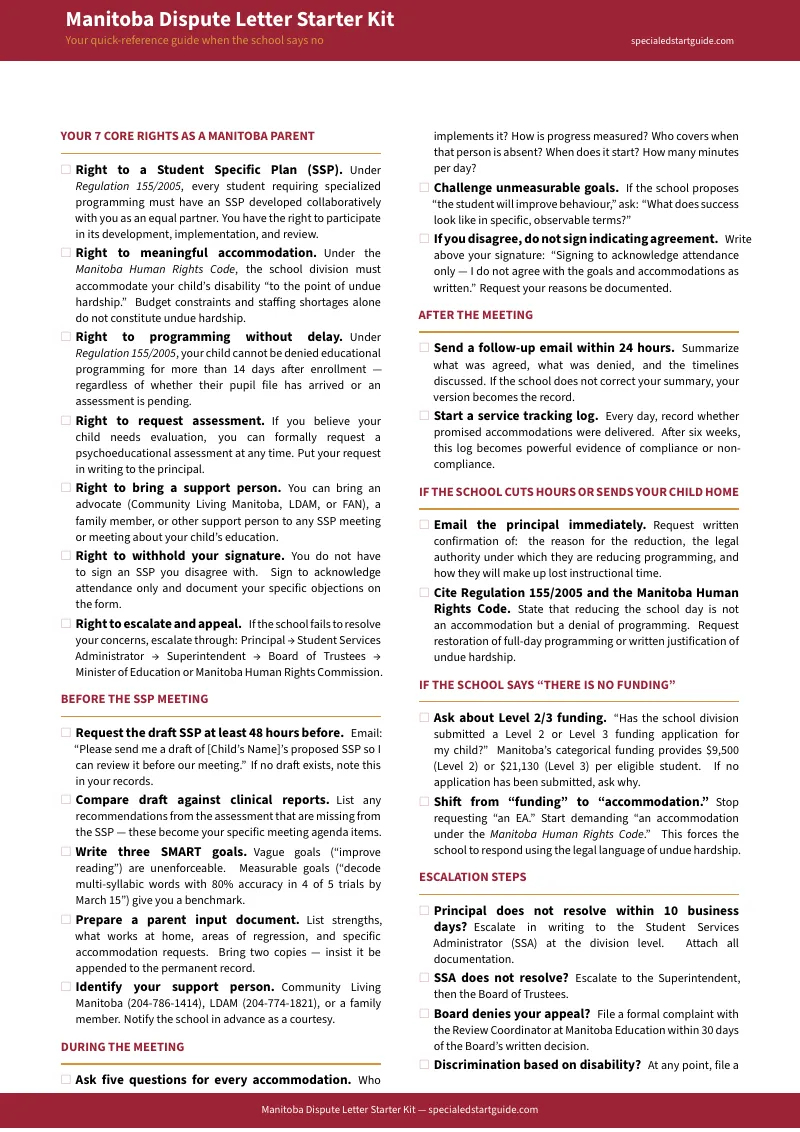
Your download includes a comprehensive 12-chapter Advocacy Playbook plus 5 standalone printable tools you can pin to your wall or bring to meetings: the complete Dispute Letter Templates (all 8 fill-in-the-blank letters with Manitoba law citations), the Escalation Roadmap (the full chain of command from classroom teacher to Manitoba Human Rights Commission), the Level 2 & Level 3 Funding Cheat Sheet, the Manitoba Key Contacts & Resources Directory, and the Advocacy Decision Tree. Plus the free Dispute Letter Starter Kit with a sample letter template and parent rights one-pager.
Instant PDF download. Send your first dispute letter tonight. Walk into tomorrow's SSP meeting with Manitoba law on your side.
Money-back guarantee, no time limit. If the Playbook doesn't change how you handle disputes with Manitoba schools, email us for a full refund. No questions asked.
Not ready for the full Playbook? Download the free Manitoba Dispute Letter Starter Kit — a sample dispute letter template and a parent rights one-pager covering your core rights under Regulation 155/2005, the Manitoba Human Rights Code, and the Canadian Charter. It's enough to send your first advocacy email tonight, and it's free.
Your child's education is a legal right under the Manitoba Human Rights Code and the Canadian Charter — not a favour the school grants when the budget allows. The school knows Regulation 155/2005. After tonight, so will you.