The School Says the IEP Is "Just a Working Document." The BC Human Rights Code Says Otherwise. Here's How to Use It.
You sat through the School-Based Team meeting — the principal, the Learning Support Teacher, a district specialist you'd never met before. They talked about your child's "designation," referenced "Competency-Based IEP goals" and "core competencies" like you should know what those mean, and told you the Educational Assistant hours were being reduced because the district needs to "reallocate resources across functional needs." You asked why. They said it was a staffing decision. You asked what you could do. They said to "trust the collaborative process." You left with a document full of vague goals like "developing personal awareness and responsibility" and a feeling that the outcome was decided before you walked in.
You were right. And you are not alone. British Columbia's special education system serves over 86,000 students with diverse needs across 60 school districts — roughly 15% of the entire public school population. The system is under enormous pressure: Surrey SD36 has explicitly cut EA positions while managing explosive enrollment, Burnaby SD41 ended the school year with practically depleted reserves, and Vancouver SD39 parents face intense competition for specialist time. The public psycho-educational assessment waitlist stretches 10 to 18 months — while your child falls further behind every semester. Parents who don't understand the designation categories, the pooled funding formula, or the BC Human Rights Code escalation pathway don't get heard. Parents who do, get results.
You live in a province where the IEP is explicitly classified by the Ministry of Education as a non-legal, non-binding planning tool. There are no due process hearings. There is no federal IDEA law. The entire system runs on the BC School Act, Ministerial Orders, and a funding model that gives school districts complete discretion over how to spend designation funding — which is exactly how schools justify telling you they "just don't have the EA hours." Bringing American IEP terminology into a meeting with a BC principal destroys your credibility in the first sentence.
The British Columbia IEP & Designation Blueprint is the Rights-Based Advocacy System — the enforcement toolkit that translates BC's School Act, Human Rights Code, the Supreme Court of Canada's Moore and Hewko decisions, and the Ministry's 12 designation categories into the exact meeting scripts, advocacy templates, and escalation strategies you need to secure your child's support. Every recommendation cites the applicable BC regulation or legal principle.
What's Inside the Blueprint
The Non-Legal IEP Paradox Decoded
The school will tell you the IEP is "just a working document" and not a legally binding contract — and they are technically correct under Ministry policy. But the duty to accommodate under the BC Human Rights Code is absolutely legally binding, and the Supreme Court of Canada's landmark Moore v. British Columbia (Education) decision established that special education is "the ramp that provides access to education" — not a dispensable luxury that can be cut when budgets tighten. The Hewko decision established your right to meaningful consultation. This guide teaches you how to shift every conversation from an educational planning discussion to a human rights compliance conversation that principals and superintendents cannot dismiss — using the exact language and written templates that trigger legal obligations.
The 12 Designation Categories (A Through Q) Translated
BC funds special education through a designation system with 12 categories divided into Low Incidence (Categories A through H, triggering $12,300 to $51,300 per student) and High Incidence (Categories K, P, Q, R). Your child's Category G designation for Autism triggers $24,340 in supplementary funding to the district. But schools sometimes push for a High Incidence classification when diagnostic evidence supports Low Incidence, and the designation decision directly determines how much money flows into the district's budget. The Blueprint decodes every category in plain language — what qualifies, what assessment triggers it, and the exact written language to use when you believe the school's designation recommendation doesn't match the clinical evidence.
The Pooled Funding Reality Exposed
Parents spend months — or pay $3,000 to $4,200 for a private psycho-educational assessment — to secure a designation. Then the school still says there are "no EA hours available." The reason: designation funding goes to the district's pooled inclusive education budget, not to your child. The district decides how to distribute EA hours based on "functional needs assessment" across all designated students. The Blueprint explains exactly how pooled funding works, how the triage system operates, and the specific written request that forces the school to explain in writing exactly how your child's designated support hours are being allocated.
The Competency-Based IEP Goal Auditor
BC has overhauled the IEP format, moving to Competency-Based IEPs aligned with the redesigned curriculum. If your child's goals now read like vague "core competency" statements — "developing personal awareness," "creative thinking," "social responsibility" — instead of measurable targets, those goals cannot be enforced. This guide includes a proprietary goal audit checklist that shows you how to convert every vague CB-IEP outcome into a hard, trackable metric with specific EA support hours, service frequency, and progress benchmarks that guarantee accountability.
Copy-Paste Advocacy Templates
Every template cites the exact BC regulation. Request a psycho-educational assessment and document the date you asked — because the public waitlist stretches 10 to 18 months, and without a written record, semesters vanish without action. Demand a formal IEP revision when accommodations aren't being implemented. Escalate an EA hours reduction with a letter referencing the Human Rights Code and the school's duty to accommodate. File a formal complaint with the school board superintendent. Prepare a BC Human Rights Tribunal submission. These aren't generic form letters — they're BC enforcement tools that create a documented paper trail the moment you hit send.
Adapted vs. Modified — The Dogwood and Evergreen Decision
The difference between adapted courses and modified courses is one of the most consequential decisions in your child's education. Adapted courses lead to a Dogwood Diploma with full post-secondary eligibility. Modified courses lead to an Evergreen Certificate with limited options. Schools sometimes default to modification when adaptation with proper supports is achievable — because modification requires fewer resources. The Blueprint explains how to identify when this is happening and the specific language to ensure your child stays on the Dogwood pathway.
Vancouver, Surrey, Burnaby & District-Specific Navigation
Vancouver SD39 faces intense resource strain and specialist bottlenecks. Surrey SD36 has explicitly cut EA positions while managing the province's largest enrollment. Burnaby SD41 ended the school year with practically depleted reserves. Victoria SD61 has its own support hierarchy. Rural and northern districts face traveling specialists who serve multiple districts on rotation, assessment waitlists measured in years, and the geographic impossibility of accessing private alternatives. The Blueprint teaches the provincial law every district must follow, then addresses the district-specific barriers that affect how you actually get compliance.
School-Based Team Meeting Scripts and Checklists
What to say when the team tells you "inclusion means the regular classroom" and refuses additional support. What to say when they reduce EA hours mid-year and claim it's a "staffing decision." What to say when the principal tells you the School-Based Team has decided your child doesn't need a formal assessment. Each script cites the BC regulation or legal principle that proves them wrong — so you're not arguing emotions at the table, you're citing law. The pre-meeting checklist covers BC's one-party consent recording rights under Section 184 of the Criminal Code and the specific documents you need to bring.
The Dispute Resolution Escalation Ladder
When informal advocacy fails, BC offers escalation options — but they are not clearly documented anywhere for parents. The Blueprint maps the complete chain of command: classroom teacher to principal to superintendent to school board to the BC Human Rights Tribunal. It explains the specific language and written templates for each level that force administrative response, when to file a Tribunal complaint, and how to build the paper trail that wins — because in BC, the paper trail IS the enforcement mechanism.
Transition Planning — Grade 7 to 8 and Beyond
The Grade 7 to Grade 8 transition frequently results in a catastrophic drop in support. High schools reassess and routinely strip away previously established EA hours and accommodations. The Blueprint covers the specific transition planning obligations, what documentation prevents your child from losing support during the transition, post-secondary pathways, adult services, and the critical steps to lock in accommodations before the elementary school year ends.
Who This Blueprint Is For
- Parents preparing for their first School-Based Team meeting who don't want to walk in blind against a team that does this every day — and who need to understand BC's designation categories before they're discussed at the table
- Parents whose child has been told they "don't qualify" for an Educational Assistant, a formal assessment, or a designation — and who need the regulatory language to challenge that decision
- Parents whose child has a Category G (Autism) or Category Q (Learning Disability) designation and the school still says there are "no EA hours available" — even though the designation triggered $24,340 or $12,300 in supplementary funding to the district
- Parents in Vancouver, Surrey, or Burnaby navigating districts with depleted reserves, EA cuts, and specialist bottlenecks
- Parents in rural or northern BC where the educational psychologist visits quarterly and the closest private assessor is a ferry ride away
- Parents whose child's Competency-Based IEP is full of vague goals and no measurable targets — and who need the audit checklist that converts "developing personal awareness" into trackable accountability
- Parents whose child is in Grade 6 or 7 and facing the high school transition — terrified that secondary schools will strip away previously established supports
- Parents whose child is being sent home regularly due to "staffing shortages" — a soft suspension the school doesn't document
- Parents who bought an "IEP Planner" from Etsy built for the American IDEA system and discovered that IEP, 504 Plan, FAPE, and due process hearings don't exist in BC
- Parents who contacted Inclusion BC or BCEdAccess but were told there's a waitlist, or who need independent strategy beyond what overwhelmed non-profits can provide right now
Why Not Just Use the Free Resources?
British Columbia has genuine free special education resources. The Ministry publishes the Special Education Services Manual. Inclusion BC and BCEdAccess offer workshops and advocacy. The Family Support Institute and Disability Alliance BC provide community support. Here's why parents still struggle after consulting all of them:
- The Ministry's Special Education Services Manual is a policy document designed to protect the institution, not the parent. It frames every interaction as a "collaborative team effort" and provides zero tactical advice on what to do when the school refuses an accommodation, claims budget constraints, pools your child's designation funding into general operations, or presents a completed IEP before you've provided meaningful input. The Manual explicitly states the IEP is not a legal contract — but never tells you the human rights alternative.
- District parent handbooks are expectation-management tools. Whether it's SD27, SD48, or SD61, each district handbook details Universal Design for Learning and the Response to Intervention framework with the implicit message: accept what is offered. They emphasize that funding is pooled, EA support is discretionary, and the district determines allocation. They present an idealized, frictionless, fully cooperative system that contradicts the daily reality of parents facing exclusions and resource scarcity.
- Inclusion BC and BCEdAccess do vital systemic work — but systemic demand vastly outstrips their capacity for one-on-one support. When you have an adversarial School-Based Team meeting tomorrow morning, you cannot afford to wait weeks for a volunteer advocate to return your email. This blueprint gives you independent, immediate strategy that works the moment you download it.
- AIDE Canada covers national frameworks — not BC's operational mechanics. Their Moore v. BC analysis is valuable, but they cannot tell you how Surrey's EA cuts affect your child's designation funding allocation, or how to file a BC Human Rights Tribunal complaint.
- Etsy and TPT planners organize American paperwork — they don't enforce BC rights. Walk into a School-Based Team meeting demanding your "IDEA rights" or a "504 Plan" and the principal knows immediately you're working from a guide that wasn't built for this province. Every template in this Blueprint cites the BC School Act, Ministerial Order 150/89, or the Human Rights Code — not American federal law that doesn't apply here.
- Private advocates charge $40 to $150+ per hour. Private psycho-educational assessments cost $3,000 to $4,200 with public waitlists of 10 to 18 months. Most BC families can't absorb that. The Blueprint gives you the same procedural frameworks and advocacy templates that professional consultants use — and if you do hire one, a documented paper trail saves hundreds in billable hours they'd otherwise spend figuring out your situation.
The free resources explain how BC's system should work. The Blueprint gives you the tools to make the school follow it.
— Less Than One Hour of a BC Educational Advocate
Educational advocates in British Columbia charge $40 to $150 or more per hour. Private psycho-educational assessments cost $3,000 to $4,200 — and the public waitlist stretches 10 to 18 months. If you hand a consultant a disorganized pile of IEP documents and school emails, your first several billable hours go toward them understanding your situation. The Blueprint teaches you how to organize the paper trail, decode the designation categories, audit the Competency-Based IEP goals, and draft the initial advocacy letters — either empowering you to win at the School-Based Team table without a consultant, or saving hundreds in billable hours if you do hire one.
Your download includes a comprehensive 12-chapter Blueprint guide plus seven standalone printable tools you can use independently:
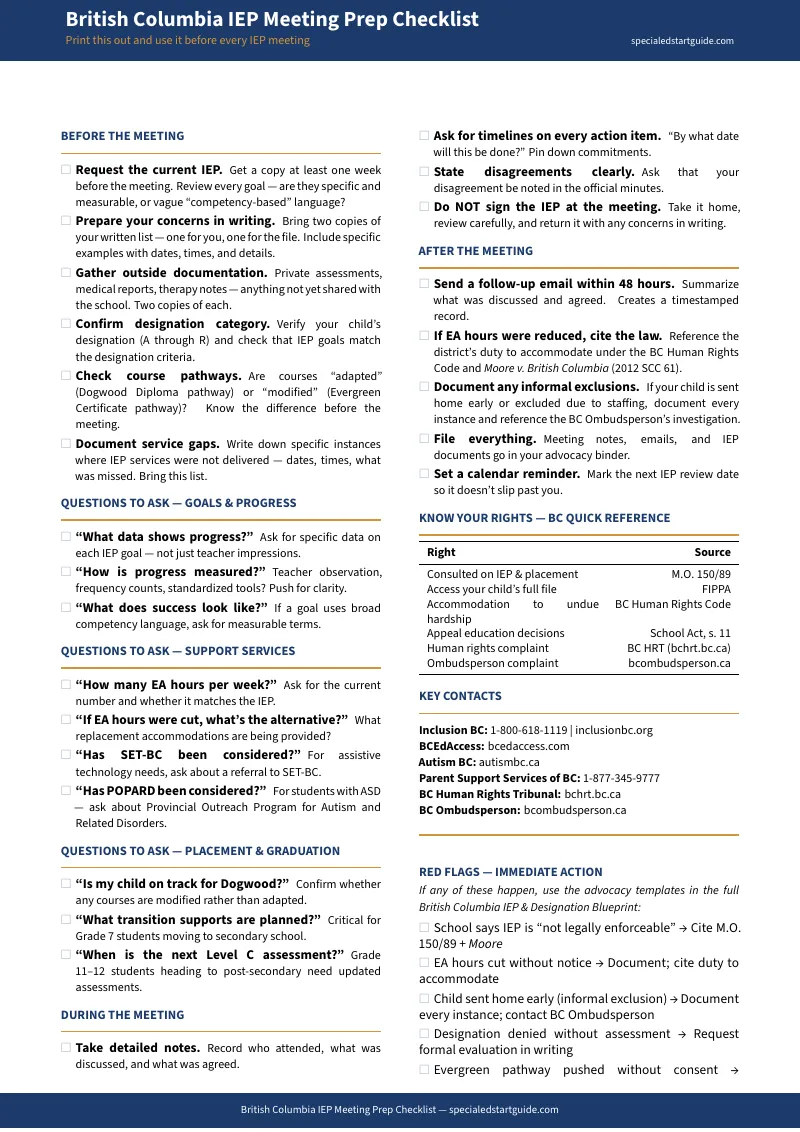
- IEP Meeting Prep Checklist — before/during/after checklists with BC timelines, School Act and Human Rights Code citations, and red flags requiring immediate action
- Advocacy Letter Templates — four copy-paste letters citing BC law: assessment request, EA reduction confirmation, informal exclusion response, and FIPPA records request
- CB-IEP Goal Audit Worksheet — fillable worksheet to audit every Competency-Based IEP goal against four accountability questions before you sign
- Designation Categories Reference — all 12 BC categories (A through Q) with funding amounts, criteria, assessment levels, and red flags for misclassification
- Dispute Resolution Roadmap — the complete BC escalation pathway from classroom teacher through the BC Human Rights Tribunal, with timelines, costs, and legal citations
- Meeting Scripts — word-for-word responses to six common school pushbacks, each citing the BC regulation or case law that supports your position
- Dogwood vs. Evergreen Reference — side-by-side graduation pathway comparison with the advocacy trap explained and an action checklist for Grade 8+ parents
The guide covers the legal framework, the non-legal IEP paradox, 12 designation categories, Competency-Based IEP goals, Dogwood vs. Evergreen graduation pathways, School-Based Team meeting strategy, dispute resolution and escalation, discipline protections, transition planning, district transfers, systemic issues, and a complete BC resources directory — with copy-paste communication templates citing the BC Human Rights Code, School Act, and Supreme Court case law.
Instant PDF download. Print the templates tonight. Walk into tomorrow's School-Based Team meeting with BC law on your side.
Money-back guarantee, no time limit. If the Blueprint doesn't change how you approach IEP meetings in British Columbia, email us for a full refund. No questions asked.
Not ready for the full Blueprint? Download the free British Columbia IEP Meeting Prep Checklist — a printable pre-meeting checklist with BC timelines, School Act and Human Rights Code citations, one-party consent recording rules, and red flags requiring immediate action. It's enough to walk into your next meeting prepared, and it's free.
Your child's education is a legal right under the BC Human Rights Code and the Canadian Charter. The school knows the School Act. After tonight, so will you.