The School Said "No." The BC Human Rights Code Says They Can't. Here's Your Next Move.
You asked for an Educational Assistant. They said "no funding." You asked why your child's designation was downgraded. They said "the team decided." You asked why your child was sent home early three times this month. They said "staffing." You asked what you could do. They said "trust the process."
The process failed your child. And every week you spend trusting it, your child loses instruction they cannot get back.
You already know the IEP isn't a legally binding contract in British Columbia. The principal told you. Maybe they said it gently — "it's a collaborative planning tool" — or maybe they said it dismissively — "it's just a working document." Either way, you walked out feeling like you had no leverage. Like the school held all the cards.
They don't. The BC Human Rights Code holds the cards. And you're about to learn how to play them.
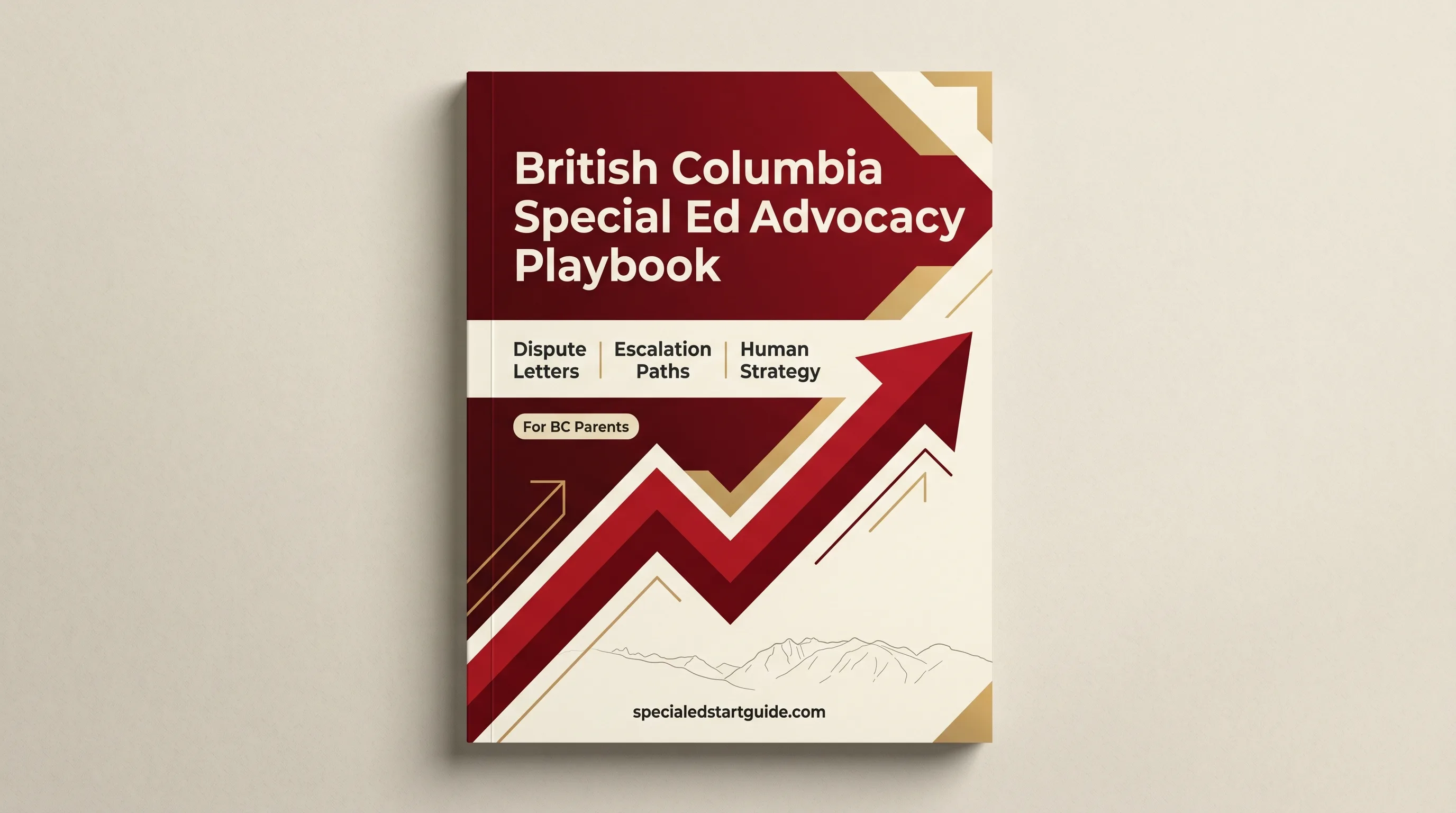
The British Columbia Special Ed Advocacy Playbook is the Dispute Escalation System — the tactical toolkit that translates the BC School Act, Human Rights Code, the Supreme Court's Moore v. British Columbia decision, and Ministerial Orders into the exact letter templates, escalation strategies, and advocacy frameworks you need to force your school district to act. Every template cites the applicable BC regulation. Every escalation step has a deadline, a recipient, and a legal citation.
What's Inside the Playbook
The Human Rights Enforcement Strategy
The IEP isn't legally binding — but the duty to accommodate under the BC Human Rights Code absolutely is. The Supreme Court's 2012 Moore v. British Columbia (Education) decision established that special education is "the ramp that provides access to the statutory commitment to education" — not a luxury that gets cut when budgets tighten. This Playbook teaches you the exact written language that shifts every conversation from an educational planning discussion to a human rights compliance conversation. When you use these phrases in an email to the principal, you are no longer requesting support — you are documenting a potential human rights violation. That changes the dynamic entirely.
5 Fill-in-the-Blank Dispute Letter Templates
Every template cites the specific BC regulation or case law that triggers the school's legal obligation to respond. EA hours reduction — cite the duty to accommodate and demand written justification for the reallocation. Designation appeal — cite Ministerial Order 150/89 and request the clinical evidence supporting the classification. Informal exclusion response — document the dates your child was sent home and cite the Human Rights Code's prohibition on discriminatory denial of services. FIPPA records request — invoke the Freedom of Information and Protection of Privacy Act to obtain your child's complete file. Section 11 appeal — formally escalate to the Board of Education within the 30-day statutory deadline. These aren't generic form letters. They're BC enforcement tools that create a documented paper trail the moment you hit send.
The Complete Escalation Pathway
When informal advocacy fails, BC offers escalation options — but they're buried across dozens of Ministry documents and non-profit websites. The Playbook maps the entire chain of command: classroom teacher to principal to superintendent to school board to the BC Ombudsperson to the BC Human Rights Tribunal. At each level, you get the specific language, the correct recipient, the filing deadline, the cost (most are free), and the template that forces a response. You'll know exactly when to escalate and exactly how to do it — because in BC, the paper trail IS the enforcement mechanism.
Designation Appeal & Reclassification Strategy
BC's 12 designation categories (A through Q) determine how much supplementary funding flows to the district. Low Incidence designations (Categories A through H) trigger $12,300 to $51,300 per student. High Incidence (K, P, Q, R) trigger less. Schools sometimes push for High Incidence when diagnostic evidence supports Low Incidence — because the designation decision determines the funding obligation. The Playbook explains how to identify when this is happening, what clinical documentation to obtain, and the written request that forces a reassessment using language the school cannot procedurally ignore.
EA Hours Documentation System
Your child's designation triggered supplementary funding to the district. But that funding goes to the pooled inclusive education budget — not to your child directly. The district decides allocation through a "functional needs assessment" across all designated students. When the school says "no EA hours available," the Playbook gives you the specific written request that forces the district to disclose in writing how your child's support hours are being allocated. Budget opacity is the school's strongest defense. Transparency is your strongest weapon.
Informal Exclusion Response System
Your child sent home early due to "staffing shortages." Barred from the field trip for "safety reasons." Reduced to half-days because "we don't have coverage." These are informal exclusions — undocumented removals that deny your child's right to education without triggering the formal suspension protections of the School Act. The Playbook's documentation strategy and response template transforms each incident from an undocumented event into a recorded human rights violation that accumulates into an actionable pattern.
IEP Meeting Advocacy Framework
What to say when the School-Based Team tells you "we're doing our best with limited resources." What to say when they reduce services mid-year and call it a "staffing decision." What to do when the IEP is presented as a finished document before you've had meaningful input. The Playbook gives you the advocacy strategies, the pre-meeting preparation checklist with BC recording consent rules (Criminal Code Section 184), and the post-meeting follow-up protocol that pins every verbal commitment to a written record.
The Moore Decision — Your Legal Foundation
In 2012, the Supreme Court of Canada ruled unanimously that cutting Jeffrey Moore's specialized reading program due to budget constraints constituted discrimination. The Court declared special education is "not a dispensable luxury." The Playbook decodes this landmark decision into plain language and shows you exactly how to reference it in written communications — because an email that includes "I am concerned this reduction may constitute a failure to accommodate to the point of undue hardship, per Moore v. British Columbia (2012 SCC 61)" carries fundamentally more weight than a verbal complaint in a hallway.
Who This Playbook Is For
- Parents whose child's EA hours have been cut or reallocated without adequate explanation — and who need the written request that forces the district to justify the decision on the record
- Parents whose child is being informally excluded — sent home early, barred from activities, or reduced to part-time attendance — and who need documentation templates to build an actionable pattern
- Parents who believe their child's designation was classified as High Incidence when diagnostic evidence supports Low Incidence — and who need the appeal language to force reassessment
- Parents told "the IEP is just a working document" and left feeling powerless — who need to understand why the Human Rights Code gives them enforceable leverage the School Act doesn't
- Parents facing a hostile or dismissive School-Based Team who need pre-meeting preparation and post-meeting documentation strategies specific to BC law
- Parents who contacted Inclusion BC or BCEdAccess but face a waitlist — who need independent, immediate advocacy tools tonight
- Parents considering a BC Human Rights Tribunal complaint who need to build the paper trail that demonstrates they fulfilled their duty to facilitate the school's process first
- Parents in Surrey, Vancouver, Burnaby, or northern BC navigating districts with EA cuts, depleted reserves, and multi-month assessment waitlists
Why Not Just Use the Free Resources?
British Columbia has genuine free advocacy organizations. Inclusion BC publishes handbooks. BCEdAccess provides rights-based education. The Family Support Institute connects parents with peer mentors. Here's why parents still get steamrolled at School-Based Team meetings after consulting all of them:
- Inclusion BC's free advocacy program is overwhelmed. Due to high demand, their one-on-one support operates on an appointment-only system with waitlists stretching weeks. If you have a hostile meeting tomorrow morning at 8:30 AM, you cannot wait for a volunteer to return your call. The Playbook gives you independent strategy that works the moment you download it.
- BCEdAccess provides rights-based education — scattered across years of blog posts and media releases. A parent in distress must spend hours navigating deep website architecture to piece together a strategy. The Playbook synthesizes this into a single, linear escalation plan with templates at every step.
- The Family Support Institute is explicitly "not an advocacy organization." They provide peer support and emotional validation — essential services — but not the combative dispute letter templates and human rights escalation scripts a parent needs when a district acts in bad faith.
- Free resources use a diplomatic, collaborative tone designed to preserve relationships. That tone works when both sides act in good faith. When the school has already said no, you need a resource that validates your anger and gives you the legally aggressive next step — not another suggestion to "keep collaborating."
- Private advocates charge $100 to $300 per hour. Special education attorneys charge $300 to $500 per hour with retainers of $5,000 or more. The Playbook gives you the same procedural frameworks those professionals use — and if you do hire one later, a documented paper trail saves hundreds in billable hours they'd otherwise spend figuring out your situation.
Free resources explain your theoretical rights. The Playbook gives you the exact letter templates to enforce them when the school says no.
— Less Than One Hour of a BC Educational Advocate
Educational advocates in British Columbia charge $100 to $300 per hour. Private psycho-educational assessments cost $3,000 to $4,200. If you hand a consultant a disorganized pile of school correspondence, your first several billable hours go toward them understanding your situation. The Playbook teaches you how to build the paper trail, draft the dispute letters, and navigate the escalation pathway — either empowering you to resolve disputes without a consultant, or saving hundreds in billable hours if you do hire one.
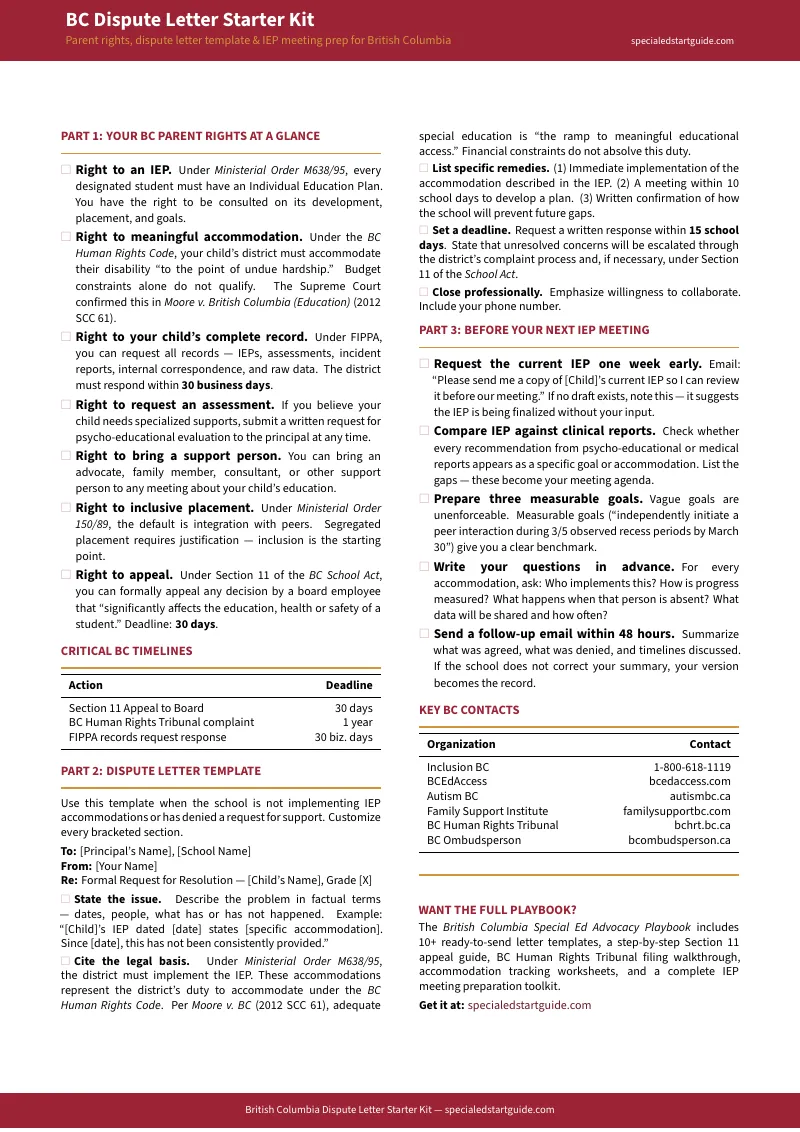
Your download includes a comprehensive advocacy guide (10 chapters covering the legal framework, designations and funding, assessment strategies, advocacy tactics, the complete escalation pathway, 5 letter templates, edge cases, monitoring systems, and a BC resources directory) plus four standalone printables: the Dispute Letter Starter Kit (parent rights one-pager, dispute letter template, and IEP meeting prep checklist), the BC Dispute Letter Templates (all 5 fill-in-the-blank letters ready to send), the Dispute Escalation Ladder (the complete BC escalation pathway on two pages), and the Designation Categories & Funding Reference (funding tiers, advocacy phrases, and red flags for designation disputes).
Instant PDF download. Print the letter templates tonight. Send your first dispute letter before the end of the week.
Money-back guarantee, no time limit. If the Playbook doesn't change how you approach disputes with your child's school in British Columbia, email us for a full refund. No questions asked.
Not ready for the full Playbook? Download the free British Columbia Dispute Letter Starter Kit — a printable dispute letter template, parent rights one-pager, and IEP meeting prep checklist. It's enough to send your first written request tonight, and it's free.
Your child's education is a legal right under the BC Human Rights Code and the Canadian Charter. The school knows the law. After tonight, so will you.