Your Child's IPP Isn't Being Followed. The School Knows You Don't Know What to Do Next. This Playbook Changes That.
The accommodations are documented. The Educational Assistant hours are written into the IPP. The speech-language referral was supposed to happen months ago. None of it materialized. You raised it at the last meeting and got the same response — nodding heads, sympathetic faces, and a promise to "look into it." Nothing changed in the classroom. Your child is still sitting without the support that was agreed upon, in writing, by the people now ignoring that document.
You tried the collaborative path. You attended every IPP meeting. You brought your notes, asked polite questions, and signed what they put in front of you. You called Inclusion Alberta and learned their capacity has been stretched thin by years of funding cuts. You downloaded Alberta Education's Learning Team Handbook — 121 pages explaining how the process should work when everyone cooperates, with nothing for the moment cooperation breaks down. You Googled "special education advocacy" and found dozens of excellent American guides referencing IEPs, 504 Plans, IDEA, and due process hearings. None of those exist in Alberta. You checked education lawyers — $350 to $500 per hour at firms like McLennan Ross and Brownlee LLP, with retainers that price real legal support out of reach.
The Advocacy Escalation System fills the gap between free government resources that assume perfect collaboration and legal counsel that costs thousands. It gives you the exact dispute letters, escalation timelines, and provincial law citations that force Alberta schools to respond in writing — so verbal promises become documented obligations with legal weight.
What's Inside the Playbook
Fill-in-the-blank dispute letter templates pre-loaded with Alberta law — because asking nicely hasn't worked, and the school needs to see Education Act and Alberta Human Rights Act citations in your correspondence before they treat your requests as legally binding obligations. Formal assessment request letters citing the Standards for Special Education. IPP non-compliance notices documenting specific accommodations being ignored by classroom staff. Emergency IPP review requests triggered by suspensions, seclusion incidents, or failed Bill 6 mandatory screening results. Post-meeting follow-up confirmations that force the school to respond in writing. Each template creates the paper trail that Section 42 appeal panels and human rights adjudicators require before they take your case seriously.
The Section 42 appeal blueprint with the exact timelines most parents miss — the complete escalation pathway from informal resolution through the principal (60 operational days), to the Board of Trustees (strict 30-operational-day filing window that most parents don't learn about until it has already closed), to Review by the Minister of Education (60-day deadline). Written templates and procedural steps for each stage, because one missed deadline forfeits your statutory right to appeal.
The funding code decoder that stops schools from undercoding your child — Alberta Education's Special Education Coding Criteria (Codes 30 through 80) translated into plain language, so you know the difference between Code 44 (Severe Physical or Medical Disability, which includes ASD and FASD) and Code 54 (Learning Disability in the mild/moderate range). Schools sometimes push for a lower classification than the diagnostic evidence supports because lower codes carry fewer resource expectations. This decoder gives you the criteria and the language to challenge a coding decision with precision.
Alberta Human Rights Commission complaint guidance — when the duty to accommodate has been breached, the one-year filing deadline you cannot miss, what constitutes a prima facie case of discrimination based on disability in an educational setting, and the specific documentation that strengthens your complaint. The Alberta Human Rights Act requires accommodation "to the point of undue hardship" — and a school board's internal budget allocation decisions do not meet that legal threshold.
The paper trail system that wins disputes — the 24-hour follow-up rule, the advocacy file structure, email confirmation protocols, and student record access requests under the Student Record Regulation (AR 225/2006). If it's not documented, it didn't happen. This system ensures that everything the school promises — and everything they deny — exists in writing.
Countering the "no funding" objection with legal precision — how the Specialized Learning Supports (SLS) Grant and Weighted Moving Average funding model actually work, why "we don't have the budget" is not a legal defence under the Alberta Human Rights Act, and the exact language to use when the school claims your child's accommodation is too expensive.
Discipline protections and seclusion safeguards — suspension and expulsion rules under the Education Act, your child's right to continued programming during exclusion, Ministerial Order #042/2019 consent requirements for seclusion and physical restraint, and what to do when discipline is applied to disability-related behaviour the school failed to accommodate.
Who This Playbook Is For
- Parents whose child's IPP says one thing but the classroom reality looks nothing like it — accommodations on paper, not in practice — who need enforceable dispute letters, not another polite conversation
- Parents who were told their child "doesn't qualify" for an assessment, an Educational Assistant, or a specialized placement, and who need the regulatory language to challenge that denial in writing
- Parents stuck in the 6-to-18-month assessment waitlist who need to formally demand interim accommodations while the school's psychologist works through the backlog
- Parents whose child lost intensive PUF supports at the Kindergarten transition and who need documentation strategies to fight for continued services in Grade 1
- Parents who discovered the Section 42 appeal process only after the 30-operational-day filing window had already closed — and who refuse to let that happen again
- Parents in Calgary, Edmonton, Red Deer, Lethbridge, or rural Alberta who need strategies that account for how their specific school division operates
- Parents who bought an American "IEP Planner" from Etsy and discovered that IDEA, 504 Plans, and due process hearings have zero legal standing in Alberta
Why Free Resources Aren't Enough When the School Stops Cooperating
Alberta Education's Learning Team Handbook is a legitimate resource — for understanding how the IPP process is supposed to work. But search it for a dispute letter template, a Section 42 appeal checklist, or guidance on filing a human rights complaint. They don't exist in that document. It was written to manage parental expectations within a collaborative framework, not to equip parents with adversarial tools when collaboration fails.
Inclusion Alberta is genuinely excellent at systemic advocacy — fighting provincial legislation like the Bill 12 ADAP benefit cuts, defending inclusive education philosophy, and supporting families at the crisis level. But they operate province-wide with limited capacity. They cannot draft your specific email to a dismissive principal at 10 PM on a Tuesday.
School board websites technically publish their Section 42 appeal procedures. They're buried in administrative regulations that most parents never find, written in language that obscures rather than clarifies the strict timelines. Edmonton Public Schools' administrative regulation spells out the 30-operational-day filing deadline — but you have to know to look for "AB.AR Dispute Resolution" in the EPSB policy manual, and most parents don't discover it until their deadline has passed.
This playbook exists because the gap between "collaborative resources" and "hire a lawyer" is where most Alberta parents get stuck — and where their child's rights quietly evaporate.
What You Get
The Alberta Special Ed Advocacy Playbook — a 12-chapter guide plus 5 standalone printable tools, all designed to work together as an advocacy system:
- The complete guide — your legal foundation, dispute strategies, human rights complaint guidance, assessment navigation, transition planning, and Alberta resources directory
- Advocacy letter templates — all 6 fill-in-the-blank dispute letters on their own, ready to print and send tonight
- Escalation ladder — the 6-step dispute pathway from principal to Alberta Ombudsman, with every deadline on one sheet
- Communication log — the printable tracking worksheet that implements the 24-hour follow-up rule from Chapter 4
- Funding code decoder — Alberta's Special Education Codes 30–80 in plain language, with red flags and challenge steps
- Advocacy decision tree — match your situation to the right template and escalation step
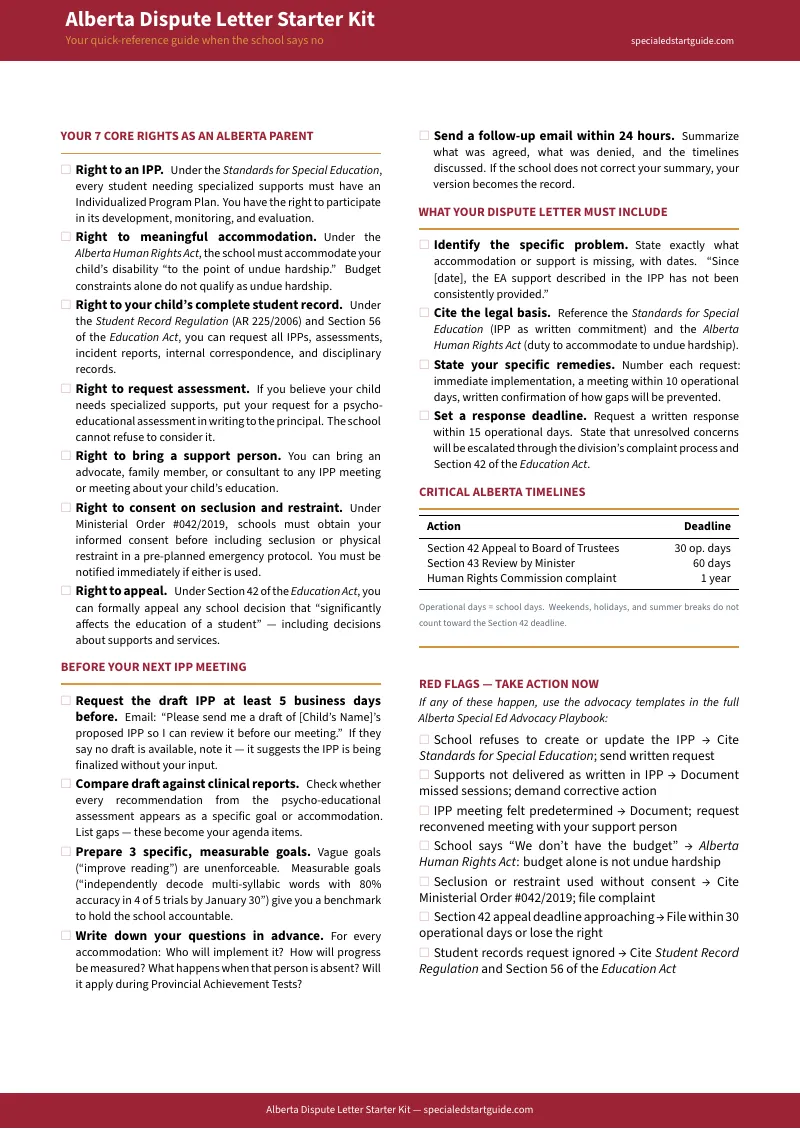
Plus the Alberta Dispute Letter Starter Kit — a standalone dispute letter template with your parent rights one-pager and critical timelines reference, ready to use tonight.
— less than 15 minutes of an education lawyer's billing rate.
100% Satisfaction Guarantee
If the playbook doesn't give you the advocacy tools you need, email hello@specialedstartguide.com and we'll refund every cent. No forms, no hoops, no questions.
Your Child's Next IPP Meeting Doesn't Have to End the Same Way
Download the free Alberta Dispute Letter Starter Kit and send your first formally documented request tonight. When you're ready for the full escalation system — Section 42 appeal blueprints, funding code decoder, human rights complaint guidance, and the complete template library — upgrade to the full Playbook.