DDWA Stopped Providing Individual Education Advocacy. The School Knows. This Playbook Means You Don't Need to Wait for Someone Who Isn't Coming.
The school emailed your child's Documented Plan review on a Friday afternoon. The SSG meeting is Wednesday. The adjustments agreed at last term's meeting were never implemented — your child is still being sent home early every time they dysregulate, the Education Assistant hours have quietly dropped, and the goals on the plan haven't changed since the last review cycle. You want to push back, but you don't know the exact words that force the system to respond.
You searched for help. PWdWA has a waitlist. DDWA — the organisation that published the best parent advocacy resources in Western Australia — has ceased providing individual education advocacy as of March 2026. Their PDFs are still online. Their advocates are not. The Department of Education's complaint page tells you to "have a conversation with the principal" — the person who created the problem. And every digital toolkit you found on Etsy teaches you to demand a "504 Plan" under a law that does not exist in Australia.
The WA Dispute Escalation System is seven ready-to-adapt letter templates, the complete complaint escalation pathway from the principal's office to the Australian Human Rights Commission, and the specific legislative citations — DSE 2005, Equal Opportunity Act 1984, School Education Act 1999 — that transform a parent's frustrated email into a formal demand the Department cannot file and forget.
What's Inside
The Complete WA Escalation Pathway
Schools rely on parents not knowing who sits above the principal. The Playbook maps the exact bureaucratic hierarchy: Principal → Coordinator Regional Operations (CRO) at your Regional Education Office → Lead School Psychologist → Director General via the Parent Liaison Office → Equal Opportunity Commission → WA Ombudsman → Australian Human Rights Commission. Each tier has different powers, different evidence requirements, and different timelines. Statutory bodies will send you back if you skip a step — the Playbook tells you when to move through them quickly and when to bypass the internal chain entirely. Includes contact numbers for every WA regional office: North Metropolitan, South Metropolitan, Goldfields, Kimberley, Mid West, Pilbara, South West, and Wheatbelt.
Seven Ready-to-Adapt Letter Templates
A well-drafted formal letter citing the DSE 2005 and the Equal Opportunity Act 1984 changes the dynamic immediately — because schools respond to specific legislative citations that define their obligations. The Playbook includes templates for: Formal Demand for Adjustment Implementation, IDA Appeal Letter, Informal Exclusion Cease Letter, Documented Plan Non-Compliance Demand, Suspension Appeal for Disability-Related Behaviour, Escalation to Regional Education Office, and Equal Opportunity Commission Complaint. Each template includes the legislative citations, the required evidence attachments, and the response timeline to demand.
IDA Funding Dispute Strategies
When the school says your child's Individual Disability Allocation application was rejected — or when IDA funding was approved but the allocated EA hours have been quietly reduced — the Playbook gives you the evidence checklist, the appeal letter template, and the script for when the school equates "no IDA" with "no obligation." The DSE 2005 requires reasonable adjustments regardless of funding category. The school's internal budget is not your child's problem.
Informal Exclusion Counter-Scripts
The moment the school calls you to "pick your child up early because they are unsettled," your child is being informally excluded from education. No suspension logged. No formal process followed. No time-bound re-engagement plan. This is the most common and least documented form of discrimination in WA schools — and it is unlawful under both the DSE 2005 and the School Education Act 1999. The Playbook provides the immediate-response email template, the demand for a formal risk assessment, and the escalation letter when the practice continues.
Documented Plan Conflict Resolution
When the school presents a Documented Plan with goals that haven't changed in two review cycles, when agreed adjustments aren't being implemented, when a new teacher ignores the existing plan entirely — the Playbook provides the formal non-compliance letter, the demand for an emergency Student Support Group meeting, and the escalation pathway when the school treats the Documented Plan as compliance paperwork rather than a binding commitment.
Suspension Appeals for Disability-Related Behaviour
When your child is suspended for behaviour directly linked to their disability and the school has not reviewed whether the Documented Plan adjustments were adequate, has not conducted a functional behaviour assessment, or has not considered whether the behaviour results from the school's failure to implement agreed support — the Playbook provides the appeal letter, the demand for a behaviour review, and the discrimination complaint framework.
WACE and SCSA Equitable Access Disputes
If the school has not informed you about SCSA equitable access arrangements for Year 11 and 12 examinations, submitted the application too late, or told you your child "doesn't need accommodations" because their grades are passing — the Playbook provides the SCSA dispute template, the evidence requirements, and the escalation pathway through the School Curriculum and Standards Authority.
Catholic and Independent School Complaints
Your child's rights under the DSE 2005 and the Equal Opportunity Act 1984 are identical whether they attend a government, Catholic, or independent school. The school's governance structure changes the complaint pathway — not the legal obligations. The Playbook maps the Catholic Education WA (CEWA) and Association of Independent Schools WA (AISWA) complaint processes with adapted letter templates.
Regional, Remote, and FIFO Family Advocacy
Every escalation template works regardless of postcode. For families in the Pilbara, Kimberley, Goldfields, South West, Mid West, and Wheatbelt — where the nearest private advocate is in Perth and School Psychology waitlists exceed twelve months — the Playbook includes regional office contacts and strategies for when geographic isolation means you cannot attend meetings in person. For FIFO families, it provides the written notification template asserting both parents' consultation rights and the communication protocol that prevents the school from exploiting roster gaps.
Evidence Logging Framework
When you do escalate — to the Regional Education Office, the Ombudsman, or the Equal Opportunity Commission — you hand them a chronological, referenced case file instead of a folder of frustration. If it is not in writing, it did not happen. The Playbook teaches you how to convert every informal hallway conversation, every phone call, every verbal promise into a dated, verifiable record.
Who This Playbook Is For
- Parents whose child's Documented Plan adjustments are not being implemented — and the school treats your follow-up as a personality problem rather than an accountability demand
- Parents whose child has been sent home early, placed on reduced hours, or kept out of certain classes without a formal suspension being logged — and the school has never used the word "exclusion"
- Parents whose child's IDA application was rejected without a clear explanation of what evidence was missing or what the appeal process looks like
- Parents whose child was suspended for behaviour directly linked to their disability — and no one reviewed whether the Documented Plan adjustments were adequate or even being implemented
- Parents who contacted PWdWA or DDWA and were told there is a waitlist, or that individual education advocacy funding has been discontinued
- Parents of Year 10-12 students whose school has not supported SCSA equitable access arrangements or submitted the application too late
- Parents whose child attends a Catholic or independent school and were told the DSE 2005 "applies differently" to non-government schools — it does not
- Regional and remote families where the nearest disability advocate is in Perth and the dispute with the school is happening right now
- FIFO families where the school makes decisions about your child's support while one parent is on site — without waiting for the absent parent's input
Why Not Just Use the Free Resources?
Western Australia has free advocacy resources. Here is exactly why parents still struggle after consulting all of them:
- DDWA has ceased individual education advocacy. Their static PDFs — The Parent's Dozen, the suspension guides, the school negotiation resources — remain online and are genuinely excellent. But since March 2026, DDWA can no longer assign an advocate to help you through the dispute process. The resources tell you what's possible. They cannot hold your hand through the execution.
- PWdWA's triage prioritises severe crises. PWdWA provides powerful systemic and individual advocacy — but their intake system prioritises imminent homelessness, abuse, justice system involvement, and NDIS appeals. A Documented Plan dispute or IDA funding challenge rarely qualifies for immediate, dedicated 1-on-1 support. When the school emails an inadequate plan on a Friday afternoon and your meeting is Wednesday, you cannot wait four weeks for an advocacy intake.
- Department of Education complaint guidance protects the system. The Department's "Let's talk about your concerns" framework encourages local resolution — through the principal who created the problem. The language is sanitised and protective. It does not include aggressive templates, specific legislative citations, or a realistic assessment of what happens when "local resolution" fails because the school is the barrier.
- AHRC and EOC guides are written for lawyers, not parents. The Australian Human Rights Commission and the WA Equal Opportunity Commission publish comprehensive legal guides — but the language is codified, academic, and intimidating. Filing a formal complaint is the nuclear option. Parents need tactical tools for the months of documented advocacy that should happen before reaching a tribunal — and those tools do not exist in the free ecosystem.
- American IEP templates are actively dangerous in WA. Demanding a "504 Plan" or citing "IDEA" in a letter to a WA principal signals that you do not understand the system. The school will use that against you. Every template in this Playbook is built on WA and Commonwealth law — not imported from Texas.
The free resources explain the philosophy. This Playbook gives you the tactical tools to enforce the obligations.
— Less Than Twelve Minutes With a Perth Disability Advocate
Private disability advocates and inclusion consultants in Perth charge $150 or more per hour. A single two-hour meeting to review your case costs $300. This Playbook gives you the same foundational letter templates, escalation contacts, and complaint procedures that professional advocates deploy — so if you do hire one, you skip the expensive orientation session where they reconstruct your timeline, and your advocate can immediately focus on the complex tactical work that justifies their fee.
Your download includes the complete Playbook guide plus five standalone printable tools:
- Complete Advocacy Playbook (guide.pdf) — 13 chapters covering the full escalation pathway, IDA funding disputes, informal exclusion counter-scripts, Documented Plan conflicts, suspension appeals, WACE equitable access disputes, Catholic and independent school complaints, regional and remote advocacy, FIFO family strategies, Aboriginal student advocacy, mainstream vs ESC disputes, seven letter templates, evidence logging, and key contacts
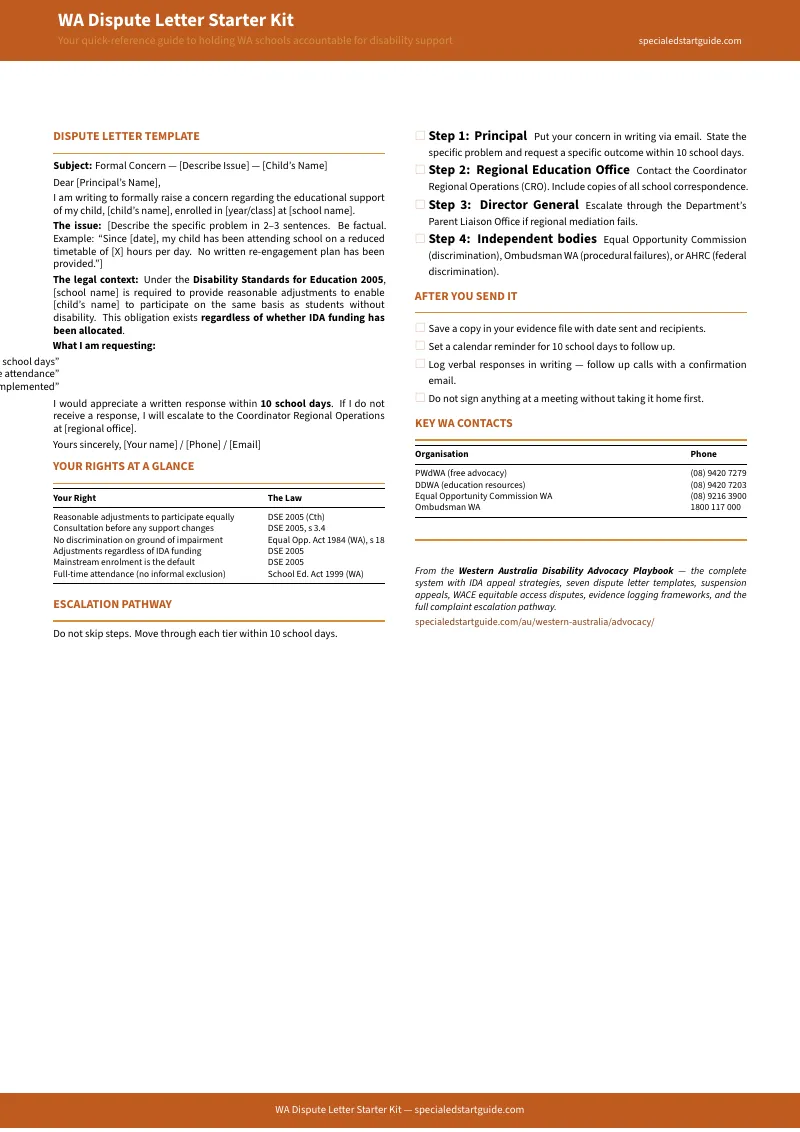
- WA Dispute Letter Starter Kit (checklist.pdf) — parent rights one-pager covering the six key legal obligations every WA school must comply with, the four-step escalation pathway with contacts, a sample dispute letter template, and a post-send follow-up checklist
- Letter Templates (letter-templates.pdf) — all seven ready-to-adapt dispute letters extracted as a standalone document: IDA denial, informal exclusion, Documented Plan non-compliance, suspension appeal, CRO escalation, SCSA equitable access, and EOC complaint
- Escalation Pathway (escalation-pathway.pdf) — the complete five-tier complaint hierarchy from principal to the Federal Court, with phone numbers for all eight WA regional education offices
- Evidence Log Worksheet (evidence-log.pdf) — printable incident log, correspondence tracker, and complaint escalation tracker with the seven-category evidence file checklist
- Advocacy Contacts (advocacy-contacts.pdf) — every advocacy organisation, statutory body, legal service, peer support group, and private assessment provider referenced in the Playbook, with phone numbers and websites
Instant PDF download. Print the escalation pathway and rights one-pager tonight. Send your first formal letter tomorrow morning.
Money-back guarantee, no time limit. If the Playbook doesn't change how you handle the next dispute with your child's school, email us for a full refund. No questions asked.
Not ready for the full Playbook? Download the free WA Dispute Letter Starter Kit — a sample dispute letter template, a one-page summary of the six legal obligations every WA school must follow, the four-step escalation pathway with key contacts, and a follow-up checklist. It's enough to send your first formal communication tonight, and it's free.
Your child's right to reasonable adjustments is not discretionary. The school knows their obligations under the DSE 2005. After tonight, you'll know them too — and you'll have the letter templates to enforce them.