You Know Your Child Has Rights. The School Knows You Don't Know How to Enforce Them.
Your child's school invited you to an SSG meeting and drafted an IEP. Then the term ended and nothing changed. The adjustments were "being implemented where possible." The goals were so vague — "will improve social skills" — that no one could prove they weren't being met, because no one was measuring them in the first place.
You tried the DET website. The Policy and Advisory Library told you the same things the school did: your child has a right to reasonable adjustments under the Disability Standards for Education 2005. What it did not tell you is how to respond when the school refuses support because you're still waiting for a funded assessment, what to say when the principal claims adjustments "cannot be funded" without Tier 3 approval, or how to prepare for a Disability Inclusion Profile meeting so your child's functional needs aren't understated by a facilitator who has never met them.
You called ACD Victoria. They're excellent — but their support line operates during business hours, and your child's SSG meeting is next Tuesday at 9 AM.
The Victoria Disability Support Blueprint is the structured system that closes the gap between what the law promises and what actually happens in your child's classroom. It gives you the meeting tactics, email scripts, legal frameworks, and escalation pathways that the DET's website leaves out — built specifically for Victoria's Disability Inclusion model, Disability Inclusion Profiles, Student Support Groups, VCAA Special Examination Arrangements, and NDIS-school coordination.
What's Inside the Blueprint
The Disability Inclusion Decoder
Victoria replaced the old Program for Students with Disabilities (PSD) with a new three-tier Disability Inclusion model. Most parents have heard this — but almost none understand what it means in practice. The difference between Tier 2 and Tier 3 funding is the difference between general school capacity and individualised aide hours for your child. When the school says "we have Disability Inclusion funding," they are usually referring to Tier 2 — money for the school, not your child. This section decodes the entire funding architecture: what each tier provides, how Tier 3 is determined, transition funding protections for former PSD students, and why the legal obligation to provide reasonable adjustments exists regardless of which tier your child qualifies for.
The DIP Meeting Preparation System
The Disability Inclusion Profile meeting determines whether your child qualifies for Tier 3 individualised funding. An independent facilitator assesses functional needs across six domains — learning and applying knowledge, general tasks and demands, communication, self-care, interpersonal interactions, and mobility. If the school presents weak evidence or fails to articulate the intensity of adjustments required, the profile outcome may not reflect your child's actual needs. This section gives you the complete evidence dossier checklist, the Translation Matrix for converting clinical diagnoses into functional needs language the facilitator scores against, prerequisite requirements the school must meet before requesting a DIP, and the appeal process if the outcome is wrong.
The IEP Goal-Writing System
DET policy requires IEP goals to be SMART — Specific, Measurable, Agreed, Relevant, Time-bound. Most Victorian IEPs contain goals that meet none of these criteria. "Will improve reading skills" is not a goal. It is an aspiration with no deadline, no measurement method, and no named person responsible for delivering it. This section gives you the fill-in-the-blank goal formula — "Given [adjustment], [child] will [action] [measurable criterion] by [date], as measured by [method]" — and demonstrates how to align goals to the Victorian Curriculum framework, including Towards Foundation Levels A-D for students with significant cognitive disability.
The SSG Meeting Equaliser
Student Support Group meetings feel rigged because they are structurally unbalanced: the classroom teacher, wellbeing coordinator, and principal sit on one side, and you sit on the other. This section gives you the meeting agenda, the conversational scripts, and the tactical responses for the phrases Victorian schools use to shut parents down — "we can't help without a diagnosis," "we're already providing adjustments," "we don't have the funding for that." You walk in with a plan. You leave with documented commitments.
The VCAA Special Examination Arrangements Guide
VCAA requires comprehensive evidence for VCE exam accommodations — and parents who discover this requirement in Year 12 are too late. Without a documented history of provisions being trialled and used in school assessments throughout secondary school, VCAA may question why accommodations are suddenly needed. This section gives you the exact preparation pathway starting from Year 9, the evidence portfolio requirements, the conditions-to-provisions mapping (which disability qualifies for which accommodation), and the SPO application timeline so your child's VCE results reflect their actual ability.
Copy-Paste Email Scripts
Every critical interaction with the school should happen in writing. This section gives you ready-to-send email templates for the situations Victorian parents face most often: requesting an IEP review, requesting SSG meeting minutes, requesting your child's DIP outcome, escalating unimplemented adjustments, and formal complaint to the DET Regional Office. Fill in the bracketed details and send. The paper trail starts tonight.
The Escalation Ladder
When the school says no and means it, you need to know exactly who to contact next — and in what order. This section maps the full Victorian complaints pathway: classroom teacher to principal to DET Regional Office to Victorian Ombudsman to VEOHRC to Australian Human Rights Commission. Each step includes who to contact, what to include, what response to expect, and when to escalate further.
Who This Blueprint Is For
- Parents whose child has a disability — diagnosed, suspected, or imputed — and is enrolled in or entering a Victorian government school
- Parents facing an SSG meeting this term who want to walk in prepared with specific questions, legal references, and meeting tactics
- Parents whose child's IEP has vague, unmeasurable goals that have not changed in over a year
- Parents who don't understand the difference between Tier 2 and Tier 3 Disability Inclusion funding — and want to know what individualised support their child is actually receiving
- Parents whose school is transitioning from the old PSD model and who need to understand what changes and what is protected
- Parents whose child is being told "we can't help until you get a diagnosis" while stuck on a waitlist that stretches past 12 months
- Parents of Year 9-12 students who need to build the evidence portfolio for VCAA Special Examination Arrangements before it's too late
- Parents whose child has been suspended or placed on a reduced timetable because the school cannot manage disability-related behaviour
- Parents whose child has NDIS funding and need to understand which supports are the school's responsibility and which are NDIS-funded
- Families across Melbourne and regional Victoria — Geelong, Ballarat, Bendigo, Shepparton, Mildura, the Latrobe Valley — facing the same Disability Inclusion system with fewer local advocacy services
Why Not Just Use the Free Resources?
DET's Policy and Advisory Library will tell you that your child has a right to reasonable adjustments. ACD Victoria will confirm it. Amaze will explain what adjustments look like for autistic students specifically. None of them will give you the email template to send tonight when the school refuses to put an agreed adjustment in writing.
- DET tells you the rules. This Blueprint gives you the tactics for when the school breaks them.
- ACD Victoria provides excellent free factsheets and a support line. This Blueprint is the advocate in your inbox at 10 PM the night before a meeting — no waitlist, no business hours.
- Amaze is the gold standard for autism-specific support. But if your child has dyslexia, ADHD, intellectual disability, or a physical condition, Amaze's resources don't cover the advocacy strategy for those disability types.
- Etsy and Amazon sell IEP planners for US families. They reference IDEA, Section 504, and IEP teams — none of which exist in Victoria. Using US terminology in a Victorian SSG meeting signals that you don't understand the system you're navigating.
Free resources explain what the law says. This Blueprint gives you the tools to make the school follow it.
— Less Than 10 Minutes With a Private Disability Advocate
A private special education advocate in Melbourne charges $150-$300 per hour, with comprehensive packages exceeding $2,000. The meeting tactics, email scripts, and escalation pathways in this Blueprint cost a fraction of that — and you can use them at every meeting, every review, every year your child is in school.
Your download includes the complete guide, 7 standalone printable tools, and the meeting prep checklist — 9 PDFs, instant download:
- Complete Blueprint Guide (12 chapters) — Victoria's legal framework (DDA 1992, DSE 2005, Equal Opportunity Act 2010, Education and Training Reform Act 2006), the Disability Inclusion three-tier funding model, Disability Inclusion Profile meeting preparation with the Translation Matrix, IEP SMART goal-writing formulas aligned to the Victorian Curriculum, SSG meeting strategy and pushback scripts, adjustments by disability type with classroom strategies, escalation pathways from principal to VEOHRC to AHRC, VCAA Special Examination Arrangements multi-year timeline, NDIS-school coordination, special considerations for suspensions and reduced timetables, the evidence system framework, and key contacts across Victoria
- DIP Translation Matrix — standalone printable converting clinical diagnoses into the functional needs language DIP facilitators score against, with all 6 assessment domains and 4 NCCD adjustment levels
- IEP Goal-Writing Formulas — the fill-in-the-blank SMART formula, 5 disability-specific examples aligned to the Victorian Curriculum, and the red flag checklist for rejecting inadequate draft goals
- SSG Meeting Scripts — 8 word-for-word responses for the phrases Victorian schools use to shut parents down, each citing the DSE 2005 or DDA 1992
- Advocacy Email Templates — 6 ready-to-send emails: IEP implementation follow-up, escalation to principal, formal DET complaint, VCAA evidence portfolio request, conversation summary, and SSS assessment referral
- VCAA SEA Timeline — the Year 9 to Year 12 preparation pathway for securing VCE exam accommodations, with the evidence portfolio requirements and senior secondary pathway options
- Escalation Pathway — the full Victorian complaints ladder from classroom teacher to the Australian Human Rights Commission, with DET regional coverage and key contacts
- IEP Goal Tracking Worksheet — fillable tracker for 4 goals across 4 terms, SSG meeting log, and evidence checklist
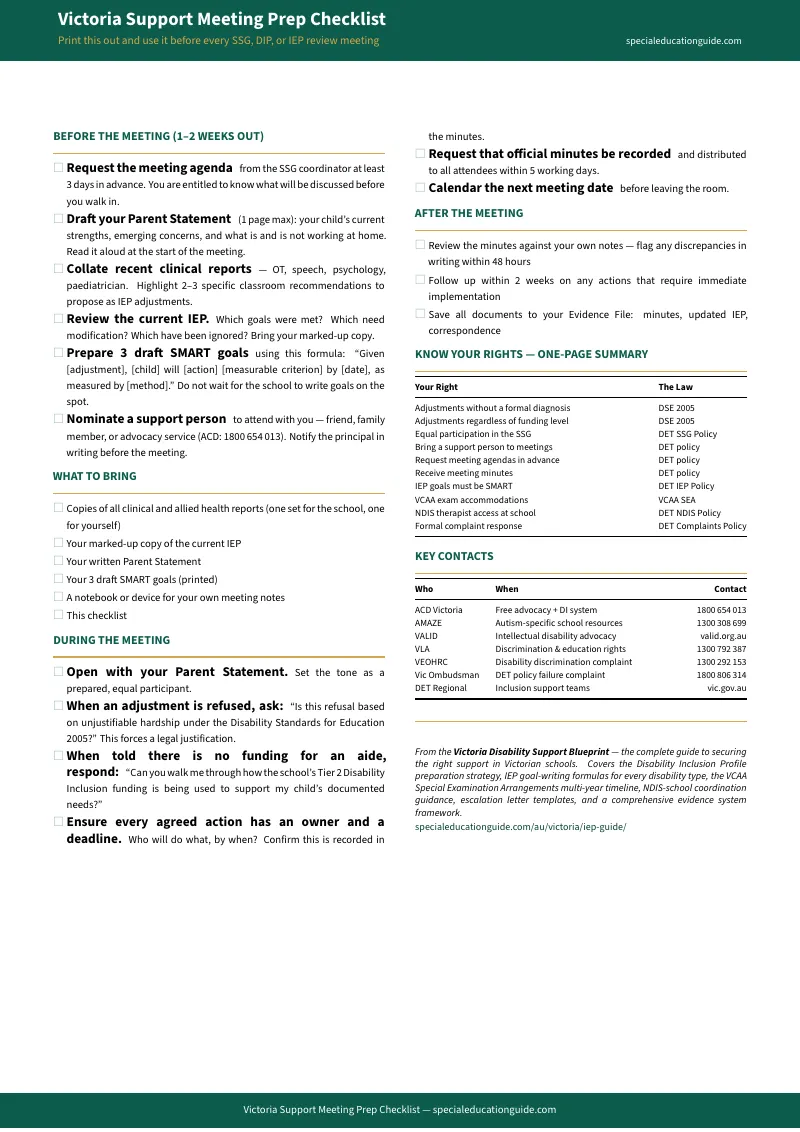
- Victoria Support Meeting Prep Checklist — one-page pre-meeting preparation steps, during-meeting scripts with legal rights phrases invoking the DSE 2005, and post-meeting follow-up actions to lock in commitments
Instant PDF download. Print the standalone tools tonight. Walk into your next SSG meeting prepared.
Money-back guarantee, no time limit. If the Blueprint doesn't change how you approach your child's school meetings, email us for a full refund. No questions asked.
Not ready for the full Blueprint? Download the free Victoria Support Meeting Prep Checklist — a one-page pre-meeting guide with what to bring, questions to ask, and key rights phrases to use when the school pushes back. It's enough to walk into your next meeting more prepared than last time, and it's free.
Your child's next SSG meeting will go one of two ways. This Blueprint determines which one.