The School Says "We'll Develop a Transition Plan." Meanwhile, the SLES Clock Is Ticking, Centrelink Won't Process Your DSP Until the Medical Evidence Is Right, and No One's Mentioned That Pediatric Services End at 18. This Is the Roadmap That Actually Gets Your Child From School to Adult Life.
Your child's school has a transition coordinator. You met them briefly at a meeting where someone mentioned "post-school options" and "exploring employment interests." They handed you a brochure from the NDIA. They might have mentioned SLES. Nobody explained that SLES providers operate on a $22,000 annual block funding model with no hourly price controls — meaning the difference between a genuinely life-changing programme and what parents on Reddit call a "SLES rort" comes down entirely to whether you know the right questions to ask before you sign.
So you went looking for answers. You found the NDIA's School Leaver Employment Supports booklet — thorough on funding mechanics, silent on how to vet providers or what happens when the funding runs out. You found CYDA's post-school transition report — a devastating analysis of systemic failure that validates everything you feel but gives you no checklist to follow on Monday morning. You found your state education department's factsheet — Queensland covers SET plans, Victoria covers FFYA, NSW covers the SLIK — but none of them mention Centrelink, none explain how to time the DSP application, and none acknowledge that the NDIS plan review happening six months before graduation is the single most consequential meeting of your child's life.
You are not short on information. You are drowning in it — scattered across federal agencies, state education departments, the NDIA, Centrelink, and dozens of advocacy websites, each covering one system, one jurisdiction, and one life domain at a time. What you need is someone to connect NDIS funding, Centrelink eligibility, state education pathways, employment services, healthcare transitions, housing, and legal capacity into a single chronological action plan that works across all eight states and territories. You need to know exactly what to do at age 13, 15, 16, and 18 — and what it costs you if you start late.
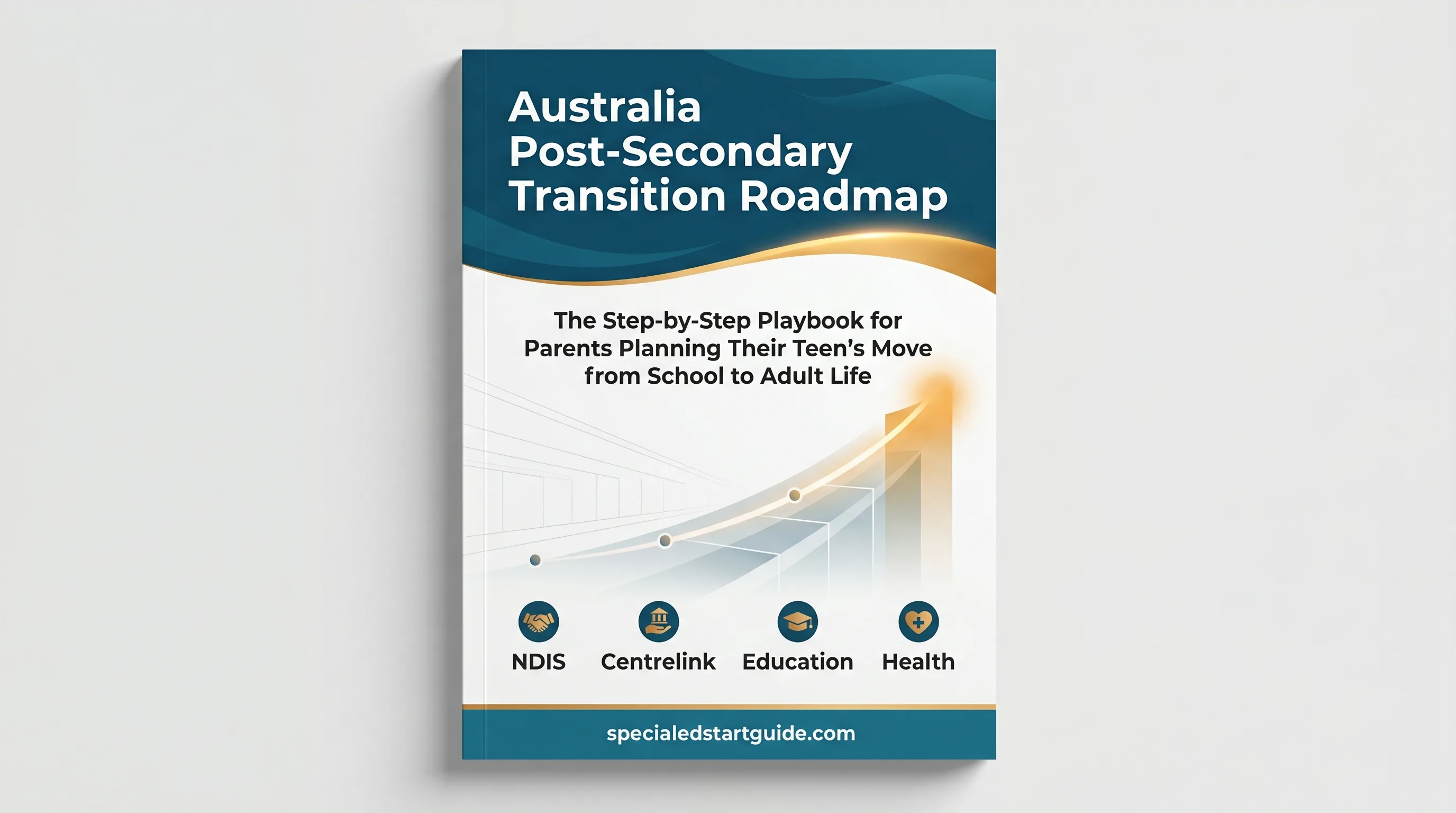
The Australia Post-Secondary Transition Roadmap is the Services Cliff Survival System — the 12-chapter operational manual that replaces the school's vague transition goals with year-by-year instructions, state-by-state service directories, the complete federal financial bridge from the NDIS to Centrelink to Medicare, and ready-to-use frameworks for every NDIS goal statement, provider evaluation, and advocacy conversation you will need between now and your child's 19th birthday.
What's Inside the Roadmap
The Services Cliff — Quantified, Not Theorized
Every parent hears that things "change after school." This chapter shows you exactly how much they change. Over one million Australian students receive educational adjustments for disability — 25.7% of total enrolments. Yet only 48% of working-age Australians with disabilities are employed, compared to 80% without. For NDIS participants aged 15 to 24, the open employment rate sits at 20%. Four out of five young people on the NDIS are not working. These are not scare tactics. These are ABS and NDIA outcomes data, and they make the case that starting transition planning in Year 8 is not early — it is barely on time.
The Complete Legal Framework for Adult Life
The Disability Discrimination Act 1992. The Disability Standards for Education 2005. The NDIS Act 2013. The Fair Work Act and Supported Wage System. The Disability Royal Commission recommendations that are reshaping employment and education obligations right now. And the shift that catches every family off guard: in school, the institution has an obligation to identify and support your child. In the adult world, your child must disclose and request. The legal chapter translates these frameworks into plain language so you know exactly what schools are obligated to provide — and what you can cite when they claim transition planning "isn't required."
State-by-State Senior Secondary Pathways
NSW's HSC Life Skills. Victoria's VCE Vocational Major and Victorian Pathways Certificate. Queensland's QCIA and SET Plan process. South Australia's SACE Modified Subjects. Western Australia's ASDAN programmes. Tasmania's formal Transition Plan requirement. The ACT's Modified courses. The Northern Territory's NTCET. Every jurisdiction mapped with the modified pathway options, tertiary admission implications, equitable assessment adjustments, and the critical question most families do not ask until it is too late: does your child's current senior pathway lead to the qualification they actually need for their post-school goal?
SLES — The $22,000 Funding Category That Makes or Breaks the First Two Years
School Leaver Employment Supports is the single most important NDIS funding line for transition-age participants. This chapter explains what SLES actually funds, how the annualised block funding model works, why the absence of hourly price controls creates both opportunity and risk, and how to write NDIS goal statements that meet the "Reasonable and Necessary" criteria for approval. It includes the SLES Provider Interview Matrix — the specific, hard questions parents should ask prospective providers to identify genuine employment-focused programmes and avoid the providers that run every participant through the same barista training regardless of their goals.
Post-School Employment Pathways
Open employment, supported employment, Disability Employment Services (DES), Australian Disability Enterprises (ADEs), customised employment, microenterprise, and the Ticket to Work model. The chapter explains how each pathway works, who qualifies, what the outcomes data actually shows, and the critical distinction between SLES (capacity-building before employment) and DES (active job seeking and placement). It addresses the "Polished Pathway" — the systemic tendency to funnel students with intellectual disabilities toward segregated sheltered workshops — and equips parents with the language and evidence to demand open employment as the starting point.
The Federal Financial Bridge — DSP, Special Disability Trusts, and NDIS Plan Management
The Disability Support Pension opens at age 16. The application requires "fully diagnosed, treated, and stabilised" medical evidence assessed against Centrelink's Impairment Tables. This chapter walks you through DSP eligibility, the application timeline, what medical evidence to compile and when to start gathering it, and the means-testing rules that apply once your child turns 18. It covers Special Disability Trusts — the tax-advantaged vehicle that protects assets for your child's long-term care without affecting their DSP eligibility — including current asset limits and establishment requirements. And it explains the three NDIS plan management options (Agency, Plan, Self) with the practical implications of each for transition-age participants who need to build financial independence.
Independent Living, Housing, and Healthcare Transition
Supported Independent Living (SIL), Individualised Living Options (ILO), and the occupational therapy assessments required months before either can be funded. Travel training — one of the strongest predictors of employment success. The healthcare transition from pediatric to adult services, including the Medicare transfer, My Health Record updates, and the medical consent shift that happens automatically at 18 whether families are ready or not. Daily living skills assessment using structured tools that document where your child is now and what capacity-building they need before graduation.
Person-Centred Planning — Keeping Your Teenager's Voice at the Centre
Transition planning that happens to a young person rather than with them produces worse outcomes. This chapter provides structured approaches for capturing your teenager's strengths, preferences, and aspirations — including adaptations for young people with complex communication needs. It explains how person-centred goals translate into NDIS plan language and IEP amendments, so the formal documents reflect what your child actually wants, not what the system finds easiest to provide.
The Master Year-by-Year Timeline
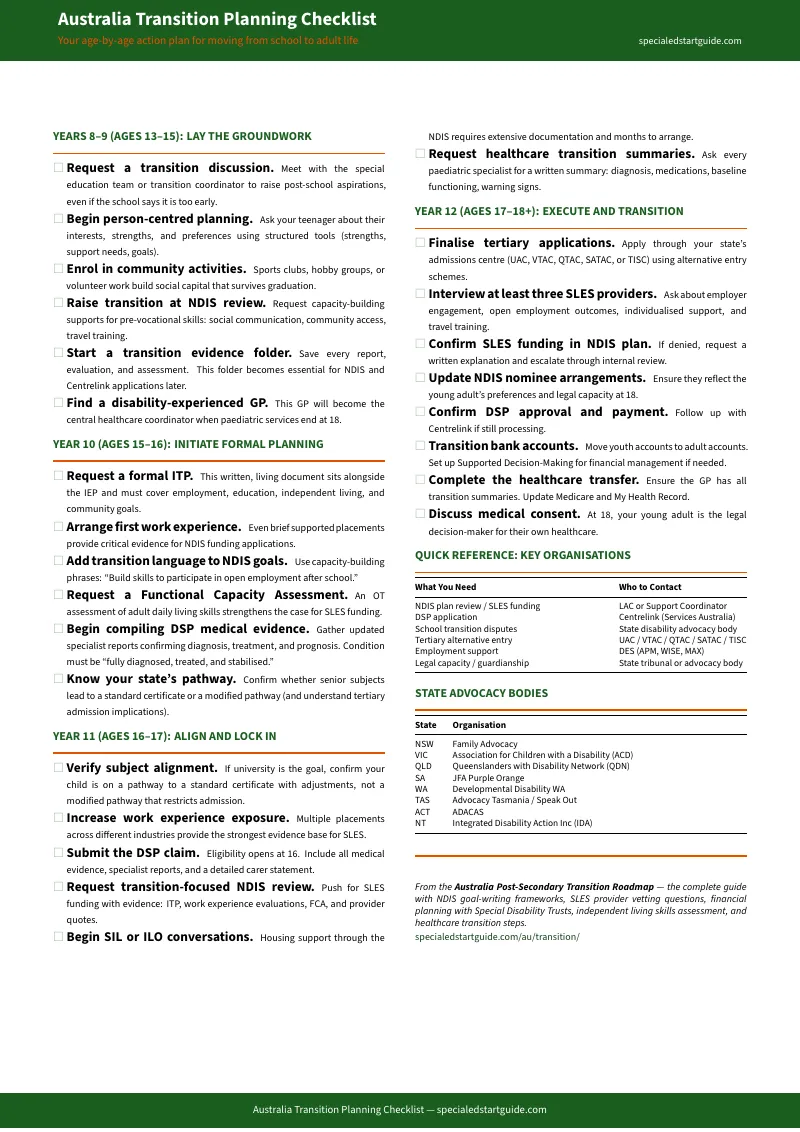
Age 13: request a transition discussion, begin person-centred planning. Age 15: arrange work experience, request a Functional Capacity Assessment. Age 16: submit the DSP claim, push for SLES-ready NDIS goals. Age 17: interview SLES providers, begin SIL conversations if relevant. Age 18: finalise tertiary applications, confirm NDIS nominee arrangements, complete the healthcare transfer. Every action dated across all four systems — Education, NDIS, Centrelink, and Health. Every consequence of delay explained. This is the project management tool that replaces the 40 open browser tabs.
Templates and Frameworks
Individual Transition Plan structures. NDIS goal statement examples that meet the Reasonable and Necessary criteria. SLES provider evaluation scorecards. IEP amendment language for inserting transition goals into existing plans. DSP evidence compilation checklists. Self-advocacy conversation frameworks your teenager can use when they need to speak for themselves for the first time.
Who This Roadmap Is For
- Australian parents of teenagers (ages 13-20) with any disability — autism, intellectual disability, ADHD, learning disabilities, physical impairments, psychosocial conditions — who need a unified plan for what happens after school
- Parents whose child's school transition plan feels generic, vague, or disconnected from the realities of NDIS funding, Centrelink applications, and adult services
- Parents who just learned about the "services cliff" and are realising the school's structured support expires but their child's needs do not
- Parents who discovered that SLES is not automatically included in their child's NDIS plan — and that the planning meeting before Year 12 determines whether the funding is there or not
- Parents navigating the DSP, NDIS plan management, and Special Disability Trusts for the first time — confused about how they connect and when to start
- Parents of students on modified pathways (QCIA, VCE VM, HSC Life Skills) who need to understand the tertiary and employment implications
- Families who have moved or are considering moving between states and need to understand how transition services differ across jurisdictions
- Parents who cannot afford a Support Coordinator at $124 per hour or a private transition consultant at $240 per hour but refuse to figure this out by trial and error
Why Not Free Resources?
Free Australian transition resources are not bad — some are excellent. They are structurally incomplete. Here is exactly where each one stops:
- The NDIA's SLES booklet explains the funding mechanism — and nothing else. It covers how block funding works but ignores state education pathways, Centrelink timelines, healthcare transitions, and housing. It says nothing about how to vet providers or what to do when a SLES programme turns out to be "not everyone wants to be a barista but that's what gets offered." This roadmap integrates SLES into a complete cross-system strategy covering all four pillars — NDIS, Education, Centrelink, and Health.
- CYDA's transition reports validate systemic failure — but give you no checklist to follow. Their research calls the process a "hidden maze" and a "nightmare." They are right. But knowing the system is broken does not tell you what to do at your child's next NDIS planning meeting. This roadmap translates systemic analysis into step-by-step actions with deadlines.
- State education factsheets cover one state and ignore the federal systems. Queensland's factsheet mentions SET plans and Taxi Subsidy Schemes. Victoria covers FFYA. NSW covers the SLIK. None of them tell you when to apply for the DSP, how to write NDIS goals that secure SLES funding, or how to manage the Medicare transfer at 18. This roadmap covers all eight jurisdictions and all four systems in one document.
- Inclusion Australia powerfully warns about the "Polished Pathway" — without the templates to disrupt it. Their advocacy is philosophically vital: the systemic default funnels disabled youth into segregated day centres rather than supporting open employment. But warning parents about the pipeline without giving them the IEP amendment language, the SLES vetting questions, and the NDIS goal statements to demand something better is diagnosis without treatment. This roadmap provides both.
— Less Than Fifteen Minutes of a Support Coordinator's Time
NDIS Support Coordinators bill at $80 to $191 per hour depending on complexity level. Private transition consultants charge $240 per hour or $1,500 for a full-day session. A comprehensive transition plan typically consumes 10 to 20 hours of coordination time — representing $1,200 to $2,400 of your child's capacity-building NDIS budget.
This roadmap gives you the same cross-system knowledge, the same SLES vetting framework, and the same NDIS goal-setting strategy those professionals use — for less than the cost of a single coordination phone call. It does not replace a lawyer for complex guardianship questions. It equips you to handle the transition planning, NDIS preparation, Centrelink applications, and provider evaluation that account for 90% of the work — so you only pay professional rates for the 10% that genuinely requires specialist input.
Your download includes 9 PDFs:
- Australia Post-Secondary Transition Roadmap (guide.pdf) — 12 chapters covering the services cliff, the legal framework for adult life, state-by-state senior secondary pathways, SLES funding and provider vetting, post-school employment pathways, the federal financial bridge (DSP, Special Disability Trusts, NDIS plan management), independent living and housing, healthcare transitions, person-centred planning, the master year-by-year timeline from age 13 to 18+, and ready-to-use frameworks for NDIS goals, provider evaluation, and self-advocacy
- Australia Transition Planning Checklist (checklist.pdf) — An age-by-age action plan covering critical milestones from Years 8-9 through Year 12 across all four systems (Education, NDIS, Centrelink, Health), plus the key organisations quick reference table
- Transition Timeline (transition-timeline.pdf) — The master year-by-year grid covering all four systems (Education, NDIS, Centrelink, Health) from Years 8-9 through Year 12+, printable as a fridge sheet
- NDIS Goal Statements (ndis-goal-statements.pdf) — Weak-versus-strong goal examples for employment, independent living, SLES, community participation, healthcare, and education, plus a planning meeting evidence checklist
- SLES Provider Scorecard (sles-provider-scorecard.pdf) — The 8-question interview framework with a 1-to-5 scoring grid and side-by-side provider comparison table
- ITP Framework (itp-framework.pdf) — A fillable Individual Transition Plan covering the four quadrants (Student Profile, Employment and Education Goals, Independent Living Goals, Action Matrix)
- DSP Evidence Checklist (dsp-evidence-checklist.pdf) — The complete document compilation checklist for the Disability Support Pension application, with eligibility criteria, medical report tracking, and timeline reminders
- Independent Living Assessment (independent-living-assessment.pdf) — A structured skills assessment across four domains (Personal Management, Household Autonomy, Financial Literacy, Civic and Legal Awareness) with a 1-to-5 rating scale
- Healthcare Transition Checklist (healthcare-transition.pdf) — The 5-step checklist for moving from paediatric to adult services, with specialist tracking fields and a mental health reminder
You can also download the Australia Transition Planning Checklist for free — a standalone age-by-age action plan covering every critical milestone across Education, NDIS, Centrelink, and Health, so you can see exactly what needs to happen at each stage before committing to the full roadmap.