
You Know Your Child Has Rights. The School Knows You Don't Know How to Enforce Them.
Your child's school told you they provide adjustments. They invited you to an SSG meeting and drafted a Learning Plan. Then the term ended and nothing changed. The adjustments were "being provided where possible." The goals were so vague — "will improve social skills" — that no one could prove they weren't being met, because no one was measuring them in the first place.
You tried the DECYP website. It told you the same things the school did: your child has a right to reasonable adjustments under the Disability Standards for Education 2005. What it did not tell you is how to respond when the school refuses support because you're still on a 448-day waitlist for a school psychologist assessment, what to say when the principal claims adjustments "cannot be funded" without a formal diagnosis, or how to challenge a Learning Plan on the Case Management Platform that has not been updated since your child's support teacher left mid-year.
You called ACD Tasmania. They're peer-led and excellent — but sixty percent of their education cases take three to twelve months to resolve, and your child's SSG meeting is next Tuesday.
The Tasmania Disability Support Blueprint is the structured system that closes the gap between what the law promises and what actually happens in your child's classroom. It gives you the meeting tactics, email scripts, legal frameworks, and escalation pathways that DECYP's website leaves out — built specifically for Tasmania's Learning Plan process, Educational Adjustments Disability Funding Model, Case Management Platform, NCCD moderation, and TASC Reasonable Adjustments.
What's Inside the Blueprint
The Legal Framework Decoder
Three layers of law protect your child: the Disability Discrimination Act 1992, the Disability Standards for Education 2005, and Tasmania's Education Act 2016. When a school says "we can't do that," you need to know which layer they're violating. This section translates all three into plain language with exact section references, so you can cite the specific obligation the school is failing to meet — including dual enrolment rights and why the school cannot discipline behaviour that is a direct manifestation of disability.
The NCCD & Funding Decoder
Tasmania's Educational Adjustments Disability Funding Model allocates funding based on documented adjustments over the preceding twelve months — not on diagnosis alone. If the school fails to document what it does for your child, it forfeits the associated funding. This section explains how NCCD categorisation levels drive resourcing (the difference between Supplementary and Substantial is thousands of dollars per year), how to request your child's categorisation, and how to invoke the imputed disability provision when you're stuck on a diagnostic waitlist.
The Learning Plan Quality System
A good Learning Plan has goals that are specific, measurable, and time-bound — with a named person responsible for each one. Most Learning Plans in Tasmanian schools have none of these things. This section walks you through the Case Management Platform documentation requirements, shows you how to evaluate your child's current goals against the legal standard, and gives you the framework for rewriting vague aspirations into enforceable commitments that the school cannot claim it was "already meeting."
The SSG Meeting Equaliser
Student Support Group meetings feel rigged because they are structurally unbalanced: the Support Teacher, classroom teacher, and principal sit on one side, and you sit on the other. This section gives you the meeting agenda, the conversational scripts, and the tactical responses for the phrases Tasmanian schools use to shut parents down — "we can't help without a diagnosis," "we're already providing adjustments," "we don't have the funding for that." You walk in with a plan. You leave with documented commitments.
The TASC Reasonable Adjustments Guide
TASC requires comprehensive medical evidence for senior secondary exam accommodations — and parents who discover this requirement in Year 12 are too late. Without documented adjustments throughout secondary school, TASC may question why provisions are suddenly needed. This section gives you the exact preparation pathway starting from Year 10, the documentation requirements for both school-assessed and external exam provisions, and NAPLAN access request procedures.
Copy-Paste Email Scripts
Every critical interaction with the school should happen in writing. This section gives you ready-to-send email templates for the situations Tasmanian parents face most often: requesting an urgent Learning Plan review, invoking imputed disability when the school demands a diagnosis, requesting NCCD categorisation information, requesting external therapist access under NDIS, and escalating to DECYP when the school stonewalls. Fill in the bracketed details and send. The paper trail starts tonight.
The Escalation Ladder
When the school says no and means it, you need to know exactly who to contact next — and in what order. This section maps the full Tasmanian complaints pathway: classroom teacher to Support Teacher to Principal to DECYP Service Centre to Tasmanian Ombudsman to Australian Human Rights Commission. Each step includes who to contact, what to include, what response to expect, and when to escalate further.
Who This Blueprint Is For
- Parents whose child has a disability — diagnosed, suspected, or somewhere in the 448-day school psychologist waitlist — and is enrolled in or entering a Tasmanian school
- Parents facing an SSG meeting this term who want to walk in prepared with specific questions, legal references, and meeting tactics
- Parents whose child's Learning Plan has vague, unmeasurable goals that have not changed in over a year
- Parents who don't know their child's NCCD categorisation level — and want to find out what funding the school is receiving for their child's support
- Parents whose child is being told "we can't help until you get a diagnosis" while stuck on a waitlist that stretches past 14 months
- Parents of Year 10-12 students who need to prepare TASC Reasonable Adjustments documentation before it's too late
- Parents whose child has been suspended or placed on a reduced timetable because the school cannot manage disability-related behaviour
- Parents whose child is experiencing "school can't" and facing attendance concerns from a school that hasn't addressed the underlying support failures
- Families who have relocated to Tasmania from mainland Australia and need to understand how DECYP's terminology and processes differ from their previous state
- Regional and remote Tasmanian families — from the North-West Coast to the East Coast to the Huon Valley — facing long waits for Hobart-based services
Why Not Just Use the Free Resources?
DECYP's website will tell you that your child has a right to reasonable adjustments. ACD Tasmania will confirm it. Raising Children Network will explain what adjustments look like. None of them will give you the email template to send tonight when the school refuses to put an agreed adjustment in writing.
- DECYP tells you the rules. This Blueprint gives you the tactics for when the school breaks them.
- ACD Tasmania is overwhelmed — sixty percent of cases take 3-12 months. This Blueprint is the advocate in your inbox at 10 PM the night before a meeting.
- Advocacy Tasmania provides excellent support. This Blueprint gives you tactical leverage for a specific school meeting tomorrow morning.
- Raising Children Network gives national overviews. It references Victorian and NSW systems — not DECYP Learning Plans, not the Case Management Platform, not Tasmania's NCCD moderation process.
- Etsy and Amazon sell IEP planners for US families. They reference IDEA, Section 504, and IEP teams — none of which exist in Tasmania. Using US terminology in a Tasmanian SSG meeting signals that you don't understand the system you're navigating.
Free resources explain what the law says. This Blueprint gives you the tools to make the school obey it.
— Less Than 10 Minutes With a Private Disability Advocate
A private special education consultant in Australia charges over $100 per hour. A specialist education lawyer charges hundreds. The meeting tactics, email scripts, and escalation pathways in this Blueprint cost a fraction of that — and you can use them at every meeting, every review, every year your child is in school.
Your download includes the complete guide, 9 standalone printable tools, and the meeting prep checklist — 11 PDFs, instant download:
- Complete Blueprint Guide (67 pages) — 16 chapters covering Tasmania's legal framework, the Educational Adjustments Disability Funding Model, NCCD categorisation levels and their funding impact, Learning Plan development on the Case Management Platform, SSG meeting preparation and tactics, SMART goal writing, NDIS-school interface, NAPLAN and TASC Reasonable Adjustments, the diagnostic labyrinth and waitlist navigation, disability-specific adjustments, transition planning from early childhood to post-school, suspensions and reduced timetables, escalation pathways from principal to Human Rights Commission, advocacy organisations, email templates, and a complete Tasmania terminology glossary
- Meeting Preparation Guide — the complete SSG meeting preparation system: one-week-before documentation assembly, day-before goal preparation, during-meeting scripts and pushback responses, and after-meeting follow-up protocol
- Email Templates — 5 ready-to-send templates: requesting a Learning Plan, requesting a review, invoking imputed disability, post-meeting summary, and escalation to DECYP
- Learning Plan Goal Worksheet — fillable SMART goal planning sheets with weak-vs-SMART examples, the goal quality checklist, and space for 4 goals
- NCCD Reference Card — the 4 categorisation levels, funding implications, the imputed disability provision, and your advocacy actions on one page
- Legal Quick Reference — the 3 legal layers (DDA 1992, DSE 2005, Education Act 2016) with key citations and scripted responses on one page
- Escalation Pathway — the full complaints hierarchy from Support Teacher through DECYP to the Tasmanian Ombudsman and AHRC on one page
- TASC Timeline Checklist — the Year 10-12 preparation timeline for NAPLAN access requests and TASC senior secondary exam accommodations
- Transition Planning Checklist — preparation steps for every transition: early childhood to Prep, primary to high school, Year 10 pathways, between schools, and between sectors
- Key Contacts — every advocacy organisation, DECYP service, legal resource, and national support body with contact details on a printable sheet
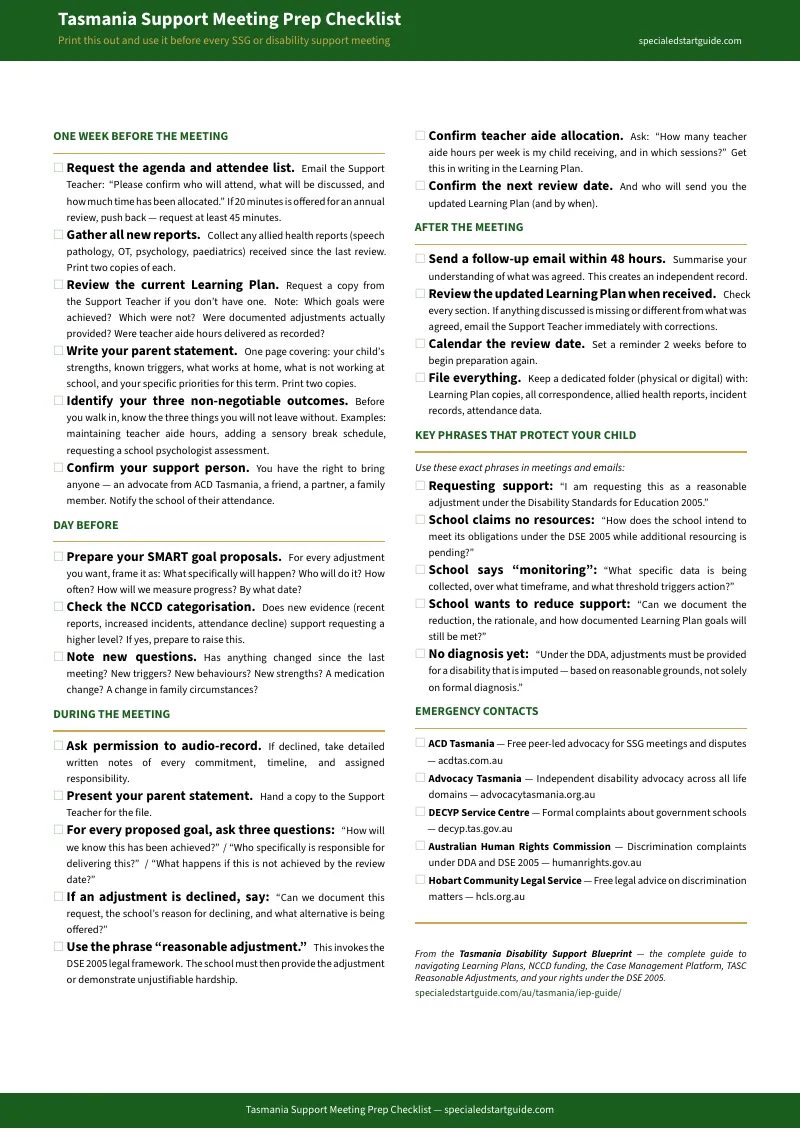
- Tasmania Support Meeting Prep Checklist — one-week preparation steps, three non-negotiable outcomes framework, meeting questions that force specificity, key rights phrases invoking the DSE 2005, and post-meeting follow-up actions to lock in commitments
Instant PDF download. Walk into your next SSG meeting prepared.
Money-back guarantee, no time limit. If the Blueprint doesn't change how you approach your child's Learning Plan meetings, email us for a full refund. No questions asked.
Not ready for the full Blueprint? Download the free Tasmania Support Meeting Prep Checklist — a one-page pre-meeting guide with what to bring, questions to ask, and key rights phrases to use when the school pushes back. It's enough to walk into your next meeting more prepared than last time, and it's free.
Your child's next SSG meeting will go one of two ways. This Blueprint determines which one.