You Know Your Child Has Rights. The School Knows You Don't Know How to Enforce Them.
Your child's school told you they provide reasonable adjustments. They invited you to a support meeting and drafted an Individual Curriculum Plan. Then the term ended and nothing changed. The adjustments were "implemented where possible." The ICP goals were so vague — "will improve social skills" — that no one could prove they weren't being met, because no one was measuring them in the first place.
You tried the Queensland Department of Education website. It told you the same things the school did: your child has a right to reasonable adjustments under the Disability Standards for Education 2005. What it did not tell you is how to respond when the school quietly redistributes your child's teacher aide hours into the whole-school RAR pool, what to say when the principal claims the school "already provides inclusion," or how to secure AARA exam accommodations before the QCAA's rigid deadlines lock your child out of a fair QCE result.
You called Queensland Advocacy for Inclusion. They're government-funded and excellent — but the waitlist is up to six months. Over 400 people went completely unserviced in a recent financial year. Your child's ICP review meeting is on Thursday.
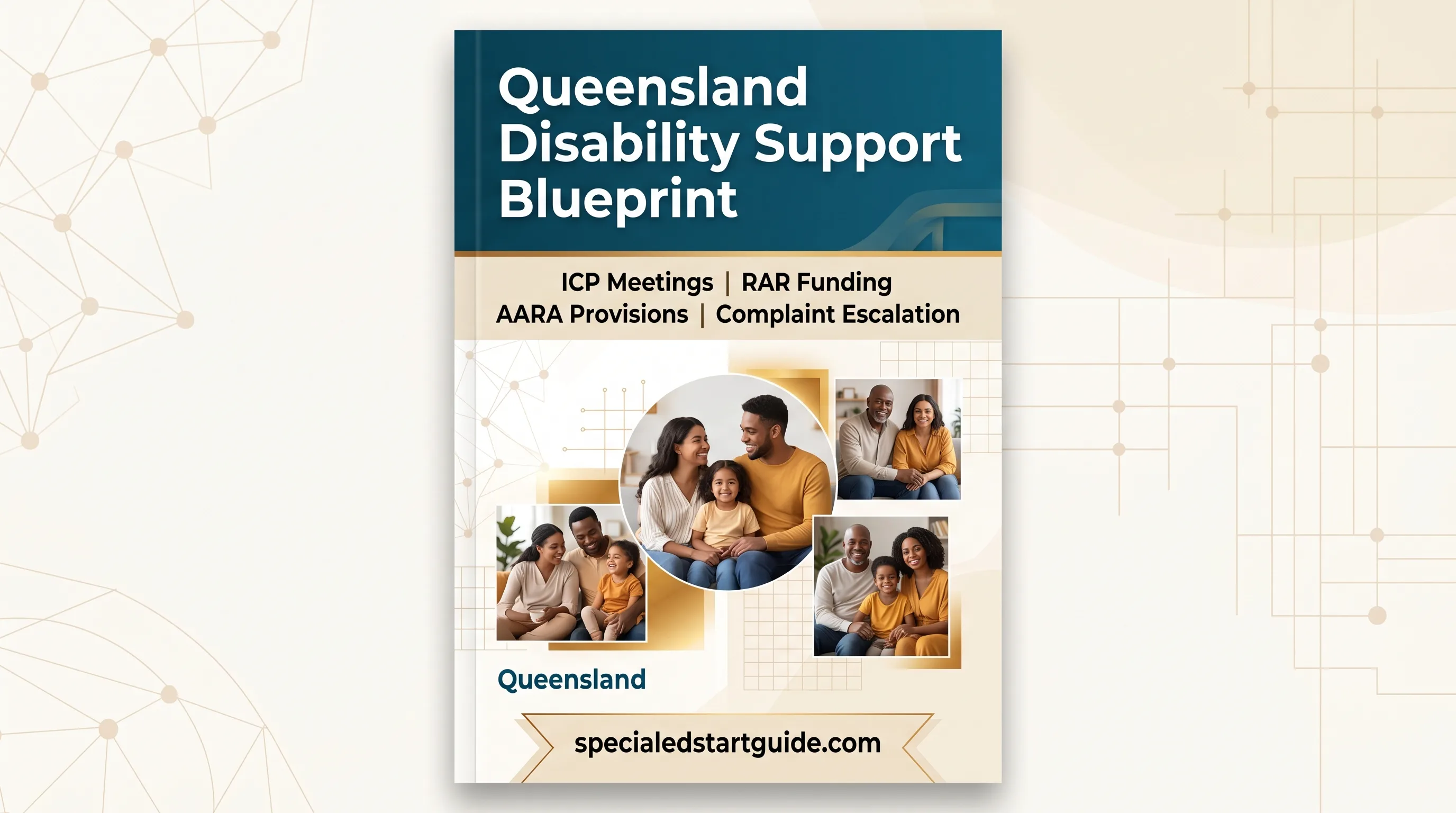
The Queensland Disability Support Blueprint is the structured system that closes the gap between what the law promises and what actually happens in your child's classroom. It gives you the meeting tactics, email scripts, legal frameworks, and escalation pathways that the Department's website leaves out — built specifically for Queensland's ICP process, EAP verification, RAR funding model, QCAA AARA provisions, and DSE 2005 complaints framework.
What's Inside the Blueprint
The QLD Legal Framework Decoder
Three layers of law protect your child: the Disability Discrimination Act 1992, the Disability Standards for Education 2005, and the Queensland Anti-Discrimination Act 1991. When a school says "we can't do that," you need to know which layer they're violating. This section translates all three into plain language with exact section references, so you can cite the specific obligation the school is failing to meet — not argue feelings against bureaucracy.
The EAP-to-RAR Funding Decoder
The transition from the Education Adjustment Program to Reasonable Adjustments Resourcing has left thousands of QLD parents confused about where their child's support hours went. Schools receive a whole-school RAR pool based on NCCD data — but parents are rarely told how that pool translates to their child's daily support. This section explains how NCCD categorisation levels drive funding, how to request visibility into your child's specific allocation, and what to do when the school uses the transition to mask a reduction in teacher aide hours.
The ICP Quality System
A good Individual Curriculum Plan has goals that are specific, measurable, and time-bound — with a named person responsible for each one. Most ICPs in Queensland schools have none of these things. This section walks you through evaluating your child's current ICP against the legal standard, rewriting vague goals into enforceable commitments, and ensuring every adjustment is documented with enough specificity that the school cannot claim it was "already being done" when it wasn't.
The AARA Senior Assessment Guide
The QCAA mandates that medical documentation for long-term conditions must be dated no earlier than January 1 of your child's Year 10 enrolment. Parents who discover this deadline in Year 11 or 12 are too late — and without a pre-approved AARA, a late Year 12 submission is automatically marked as a non-submission, destroying the QCE calculation. This section gives you the exact Year 10 preparation timeline, the documentation requirements, and the process for challenging a denied AARA application.
The Meeting Equaliser
Support meetings feel rigged because they are structurally unbalanced: the HOSES, Inclusion Coordinator, classroom teacher, and guidance officer sit on one side, and you sit on the other. This section gives you the meeting agenda, the conversational scripts, and the tactical responses for the phrases Queensland schools use to shut parents down — "we'll try our best," "the RAR pool doesn't stretch that far," "we need to consider all students." You walk in with a plan. You leave with documented commitments.
Copy-Paste Email Scripts
Every critical interaction with the school should happen in writing. This section gives you ready-to-send email templates for the situations Queensland parents face most often: requesting an urgent ICP review, documenting a verbal refusal of an adjustment, following up after a meeting to lock in agreements, escalating to the Regional Office when the school stonewalls, and requesting your child's NCCD categorisation level and RAR allocation data. Fill in the bracketed details and send. The paper trail starts tonight.
The Escalation Ladder
When the school says no and means it, you need to know exactly who to contact next — and in what order. This section maps the full Queensland complaints pathway: classroom teacher → HOSES → Principal → Regional Office → Department of Education Central Office → Queensland Ombudsman → Australian Human Rights Commission. Each step includes who to contact, what to include, what response to expect, and when to escalate further.
Who This Blueprint Is For
- Parents whose child has a disability — diagnosed, suspected, or under assessment — and is enrolled in or entering a Queensland state school
- Parents facing an ICP or support meeting this term who want to walk in prepared with specific questions, legal references, and meeting tactics
- Parents whose child's teacher aide hours have been cut or redistributed under the RAR transition without explanation
- Parents who don't know their child's NCCD categorisation level — and want to find out what funding the school is receiving for their child's support
- Parents whose child is being placed on an ICP that lowers expectations rather than providing genuine inclusion
- Parents of Year 9-11 students who need to prepare AARA documentation before the QCAA's rigid deadlines close
- Parents whose child has been suspended or placed on a reduced timetable because the school cannot manage disability-related behaviour
- Regional and remote Queensland families — from Cairns to Mount Isa to Mackay — facing long waitlists for advocacy services that never reach outside SEQ
- Parents who have tried the Department's complaints process and hit a wall — and need the next escalation step
- Parents who have been told the school "cannot afford" a reasonable adjustment — and want the exact legal response to that claim
Why Not Just Use the Free Resources?
The Queensland Department of Education website will tell you that your child has a right to reasonable adjustments. Queensland Advocacy for Inclusion will confirm it. Autism Queensland will explain what adjustments look like. None of them will give you the email template to send tonight when the school refuses to put an agreed adjustment in writing.
- The Department tells you the rules. This Blueprint gives you the tactics for when the school breaks them.
- QAI has six-month waitlists. This Blueprint is the advocate in your inbox at 10 PM the night before a meeting.
- The Department's RAR fact sheets explain the funding model. This Blueprint shows you how to demand visibility into your child's specific allocation when the school says "that information is for internal use."
- The QCAA publishes AARA eligibility criteria. This Blueprint gives you the exact Year 10 preparation timeline so you don't miss the documentation window that destroys your child's QCE result.
- Etsy and TPT sell IEP planners for US families. They reference IDEA, Section 504, and IEP teams — none of which exist in Queensland. Using US terminology in an Australian meeting signals that you don't understand the system you're navigating.
Free resources explain what the law says. This Blueprint gives you the tools to make the school obey it.
— Less Than 10 Minutes With a Private Disability Advocate
A private disability advocate in Queensland charges $51 or more per hour. A specialist education lawyer charges hundreds per hour. The meeting tactics, email scripts, and escalation pathways in this Blueprint cost a fraction of that — and you can use them at every meeting, every review, every year your child is in school.
Your download includes the complete guide plus 10 standalone printable tools:
- Complete Blueprint Guide — 15 chapters covering QLD legal frameworks, EAP verification, RAR funding, ICP development and review, NCCD categorisation levels, reasonable adjustment requests, meeting tactics, ICP goal writing, behaviour and suspension rights, assessment and evidence strategies, AARA provisions, NDIS-school interface, complaint escalation pathways, transition planning, advocacy resources, email templates, and your ongoing monitoring routine
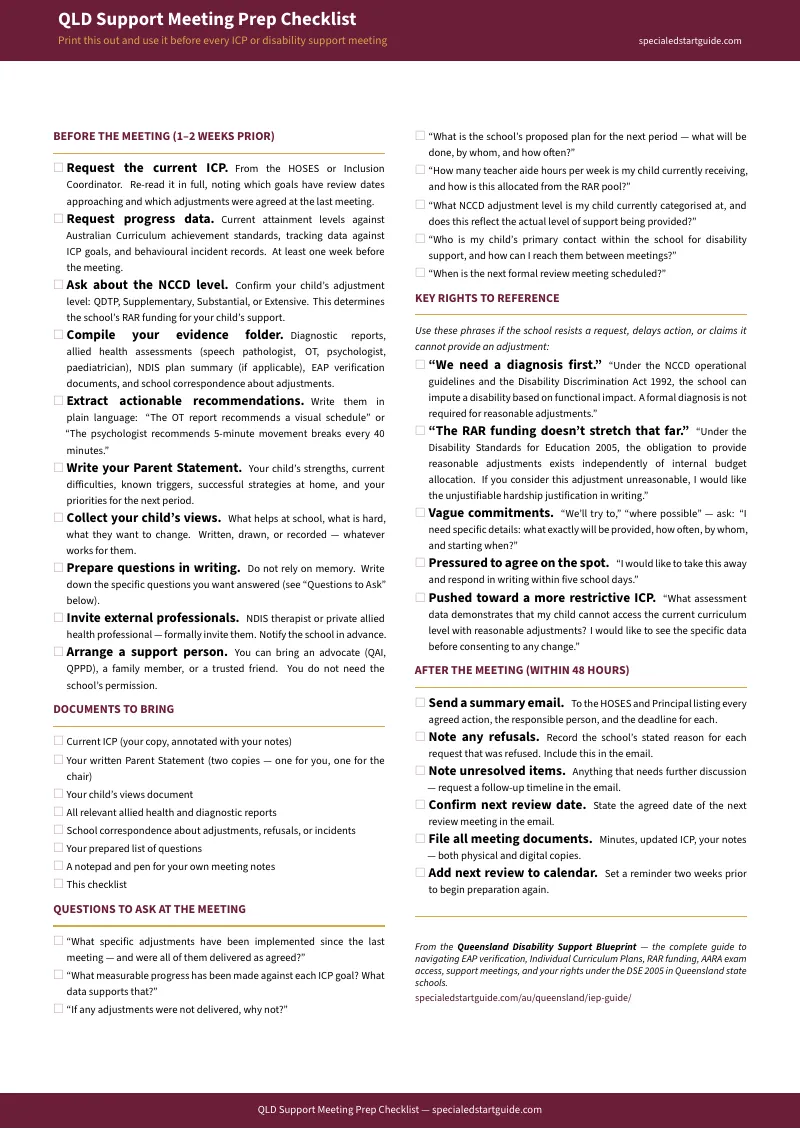
- QLD Support Meeting Prep Checklist — pre-meeting preparation, document pack list, questions to ask, key rights phrases, and post-meeting follow-up actions
- Email Templates — three copy-paste emails for requesting support meetings, confirming meeting outcomes, and escalating to the Regional Office
- Escalation Pathway — one-page visual ladder from HOSES to the Australian Human Rights Commission with timelines and contacts
- ICP Goal Worksheet — fillable worksheet for writing measurable ICP goals with weak-vs-strong examples
- Legal Quick Reference — all four layers of legal protection on one card with scripted responses for common school deflections
- NCCD Reference Card — EAP categories, NCCD adjustment levels, RAR funding model, and parent rights
- AARA Timeline Checklist — Year 10 preparation timeline with the critical documentation deadline
- Meeting Preparation Guide — detailed before/during/after meeting playbook with the pushback response table
- Transition Planning Checklist — checklists for every transition: early childhood to Prep, primary to secondary, senior secondary, and post-school
- Key Contacts Directory — QLD advocacy organisations, regional services, escalation bodies, and support resources
Instant PDF download. 11 printable files. Walk into your next meeting prepared.
Money-back guarantee, no time limit. If the Blueprint doesn't change how you approach your child's ICP meetings, email us for a full refund. No questions asked.
Not ready for the full Blueprint? Download the free QLD Support Meeting Prep Checklist — a one-page pre-meeting guide with what to bring, questions to ask, and key rights phrases to use when the school pushes back. It's enough to walk into your next meeting more prepared than last time, and it's free.
Your child's next ICP meeting will go one of two ways. This Blueprint determines which one.