
The School Has Policies. Now You Have the Letters.
Your child's school promised adjustments. They held an EAP meeting, wrote goals, and told you the Student Wellbeing and Inclusion team was "looking into it." Three months later, the classroom teacher who understood your child's needs left — part of the Territory's chronic 15%-plus annual staff turnover. The replacement arrived with no knowledge of the EAP. The verbal agreements you fought for evaporated. You were told to "give the new teacher time to settle in" while your child regressed.
You tried the NT Department of Education website. It explained what reasonable adjustments are. It did not explain what to write when the school refuses them. You called NTCOGSO — the peak parent advocacy body in the Territory — and learned they are stretched across the entire NT and cannot provide instant, document-ready support at 10 PM the night before a crisis meeting. Your child's situation is not at crisis point yet. But without intervention, it will be.
The Northern Territory Disability Advocacy Playbook is the turnover-proof dispute system that gives you what the Department's website leaves out: the exact letters to send, the specific legislation to cite, and the step-by-step escalation pathway from classroom teacher to Principal to QSSS Regional Director to the NT Anti-Discrimination Commission to the Australian Human Rights Commission. Every template names the specific NT institution, cites the specific federal or territory law, and tells you exactly who to contact and what to include.
What's Inside the Playbook
The NT Legal Rights Framework
Three layers of law protect your child — the Disability Discrimination Act 1992 (Cth), the Disability Standards for Education 2005 (Cth), and the Anti-Discrimination Act 1992 (NT). When the school says "we can't do that here," you need to know which law they are violating and which obligation they are failing to meet. This section translates all three into the specific provisions you cite in correspondence — not arguments about feelings, but references to binding legal duties. Section 24(3) of the NT Act makes "failure to accommodate a special need" a discriminatory act — most principals have never been challenged on this provision.
12 Copy-Paste Advocacy Letter Templates
Dispute letters covering the situations NT parents face most often: requesting an EAP meeting, requesting SWI team referrals, demanding reasonable adjustments under the DSE 2005, sending post-meeting confirmation emails that create binding records, issuing formal notices of concern, escalating to the Principal, escalating to the QSSS Regional Director, filing with the NT Anti-Discrimination Commission, complaining to the Australian Human Rights Commission, requesting NAPLAN disability adjustments, demanding telehealth and NDIS therapist access on school grounds, and requesting NCCD categorisation reviews. Fill in the bracketed details. Send it tonight.
The Full NT Escalation Pathway
When the school says no and means it, you need to know exactly who to contact next — and in what order. This section maps the progression: Classroom Teacher → SWI Coordinator → Principal → QSSS Regional Director → NT Department of Education central complaints → NT Anti-Discrimination Commission → Australian Human Rights Commission. Each step includes who to contact, what to include, expected response times, and when to escalate further.
The Remote Reality Toolkit
When the school claims "we don't have specialists here" as though geography voids the legal obligation, this section gives you the scripts to force compliance. Templates for mandating telehealth integration into the EAP, requiring the school to facilitate external NDIS therapist access, demanding key worker coordination models, and holding the Department accountable when on-site staff are demonstrably unavailable. The law does not disappear because the nearest speech pathologist is 500 kilometres away.
NDIS-School Coordination Scripts
Your child's NDIS therapist needs classroom access. The school says no. Or the school says "that's an NDIS matter" when you ask for educational adjustments that are clearly the school's responsibility. This section gives you the policy-backed language that dismantles both deflections — the distinction between educational adjustments (school's responsibility under the DSE 2005) and functional supports (NDIS-funded), and the formal correspondence template that forces the school to coordinate or explain its refusal in writing.
The NCCD Funding Accountability Tool
The school is claiming federal NCCD disability loading for your child's support. That funding has conditions — the school must provide documented adjustments for a minimum of 10 weeks. Most parents do not know this. This section gives you the exact question to ask: "What NCCD category and adjustment level are you recording for my child, and where is the 10-week evidence of adjustments being delivered?" Schools respond very differently when a parent understands the funding mechanism.
Discipline and Suspension Advocacy
If your child is being suspended for behaviour directly related to their disability — sensory meltdowns, task refusal from executive function deficits, social conflicts — without a Functional Behaviour Assessment, the school may be engaging in disability discrimination. This section gives you the legal framework and letter templates to challenge punitive responses that treat disability-related behaviour as a conduct issue.
Who This Playbook Is For
- Parents whose child's EAP is not being implemented — the school wrote goals and agreed to adjustments, but nothing has changed in the classroom
- Parents whose child lost Inclusion Support Assistant hours without warning because the school reallocated the aide and claims allocation is "at the school's discretion"
- Parents who paid thousands for a private psychoeducational assessment — often after flying their child to Darwin or Adelaide for testing — and the school has not acted on a single recommendation
- Parents whose NDIS-funded therapist has been denied classroom access and neither the school nor the NDIS will take responsibility
- Parents whose child is being suspended for disability-related behaviour without a Functional Behaviour Assessment or EAP revision
- Parents in remote communities — Katherine, Tennant Creek, Nhulunbuy, or across Arnhem Land — where the school uses geographic isolation as a standing excuse to deny support
- Defence families who relocated to Darwin from southern states and discovered the disability infrastructure they relied on does not exist in the Territory
- Parents whose child's teacher changed mid-year and the new teacher has no knowledge of the EAP — the replacement was told to "start fresh" with no handover
- Aboriginal families navigating a system that applies Western diagnostic frameworks without cultural context and ignores land-based and oral learning traditions
- Parents who have tried every informal approach and need the formal, legally grounded escalation steps
Why Not Just Use the Free Resources?
The free resources are valuable. They are also structurally unable to help you in the moment you need help most.
- The NT Department of Education tells you the rules. This Playbook gives you the letters to send when the school breaks them — citing the specific legislation the school is violating, addressed to the specific official who is obligated to respond.
- NTCOGSO provides outstanding parent advocacy. But their resources are stretched across the entire Territory, and securing an advocate for a meeting takes time your child may not have. This Playbook is the advocate in your inbox at 10 PM the night before you need to send a complaint.
- National advocacy frameworks reference "IEPs" and "IEP teams." The NT does not use IEPs. The NT uses Educational Adjustment Plans (EAPs), Student Support Plans (SSPs), and Individual Transition Plans (ITPs). Submitting a US-formatted IEP template instantly signals to NT educators that you are using generic internet advice — and diminishes your credibility.
- Etsy and TPT sell US advocacy templates for $5 to $40. They reference IDEA, Section 504, and IEP meetings. None of these exist in Australia. Citing US legislation in an NT school signals that you do not understand the system.
Free resources explain what the law says. This Playbook gives you the letters that make the school obey it.
— Less Than 10 Minutes With a Private Disability Advocate
A private NDIS Support Coordinator with advocacy expertise in Darwin charges $100 to $220 per hour. In Alice Springs, rates are comparable with severely limited availability — there is exactly one listed NDIS advocacy provider in Stuart Park. A psychoeducational assessment through a private practitioner costs $1,500 to $3,500 — and for remote families, that cost is compounded by flights, accommodation, and days away from work. This Playbook costs a fraction of one phone call to a private advocate — and gives you the documented advocacy system to force the school to act on the assessments you already paid for.
Your download includes 7 PDFs:
- Complete Advocacy Guide — 13 chapters covering the NT legal framework, the Department bureaucracy, EAP battleground tactics, institutional deflection countermeasures, the full escalation pathway, all 12 advocacy letter templates, disability-specific strategies (autism, ADHD, intellectual disability, FASD, sensory), NDIS-school coordination, remote and very remote advocacy, building your evidence file, support networks and resources, and a 30-day action plan
- Advocacy Letter Templates — all 12 copy-paste dispute letters as a standalone printable: EAP meeting requests, SWI referrals, DSE 2005 reasonable adjustment demands, post-meeting confirmations, notices of concern, formal Principal complaints, QSSS Regional Director escalations, NT Anti-Discrimination Commission complaints, AHRC complaints, NAPLAN adjustment requests, telehealth/NDIS therapist access demands, and NCCD categorisation reviews
- Escalation Pathway — the full NT complaints ladder from classroom teacher to the Australian Human Rights Commission, with contacts, deadlines, and expected response times — print and keep on your fridge
- Key Contacts & Resources — every NT phone number, email, and website on a single printable page: Department of Education, NT Anti-Discrimination Commission, AHRC, NTCOGSO, 54 Reasons, Carpentaria Disability Services, disability-specific organisations, and key legislation
- Evidence File & Progress Tracker — fillable worksheets for organising your documentation, tracking EAP goal progress across all four terms, and monitoring whether agreed adjustments are actually being delivered
- NDIS-School Boundary Guide — the who-pays-for-what reference table, grey area response scripts, therapist access requirements, and information-sharing agreement checklist
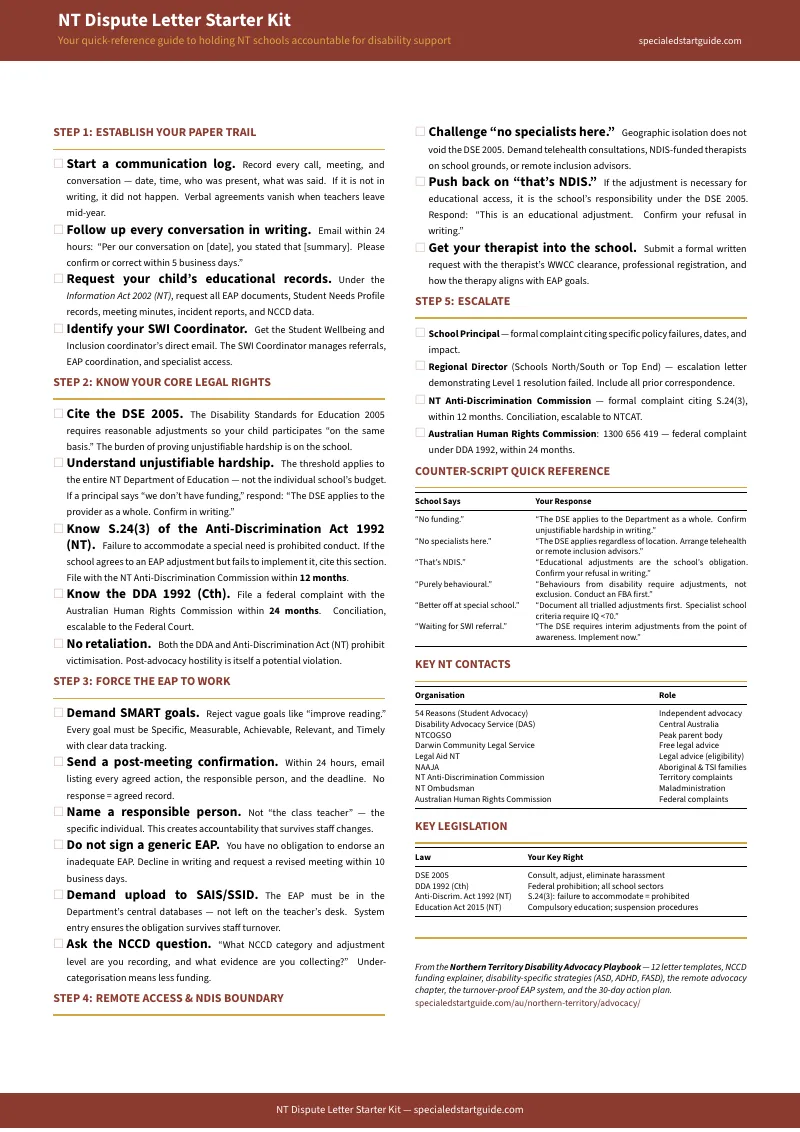
- NT Dispute Letter Starter Kit — the quick-reference checklist with paper trail protocols, core legal rights with DDA 1992, DSE 2005, and Anti-Discrimination Act 1992 (NT) citations, EAP accountability steps, NDIS-school boundary scripts, escalation contacts, and the NCCD funding question every parent should ask
Instant PDF download. Send your first dispute letter tonight. File your first complaint this week.
Money-back guarantee, no time limit. If the Playbook does not change how you handle your child's disability education disputes, email us for a full refund. No questions asked.
Not ready for the full Playbook? Download the free NT Dispute Letter Starter Kit — a quick-reference guide with the paper trail checklist, core legal rights, EAP accountability steps, key contacts, and the NCCD funding question that forces transparency. It is enough to send your first documented follow-up email tonight, and it is free.
Every day without a documented paper trail is a day the school claims compliance. Your child's next dispute does not have to be fought alone.