The School Already Has a Legal Team. Now It's Your Turn.
Your child's school promised reasonable adjustments. They held a Student Support Group meeting, wrote goals on the ILP, and told you the support was "being implemented." Three months later, the classroom teacher still has not read the $2,500 psychoeducational assessment you paid for privately. The ILP goals are so vague that no one can prove they are not being met — because no one is measuring anything. Your NDIS-funded OT needs 30 minutes in the classroom and the principal denied access, citing "operational disruption." You followed up by phone and the principal said they would "look into it." That was six weeks ago.
You tried the Education Directorate website. It explained what reasonable adjustments are. It did not explain what to write when the school refuses to provide them. You called Advocacy for Inclusion — the ACT's most respected free disability advocacy service — and learned they are triaging crisis-level cases. Your child's situation is not a crisis yet. But if nobody intervenes, it will be.
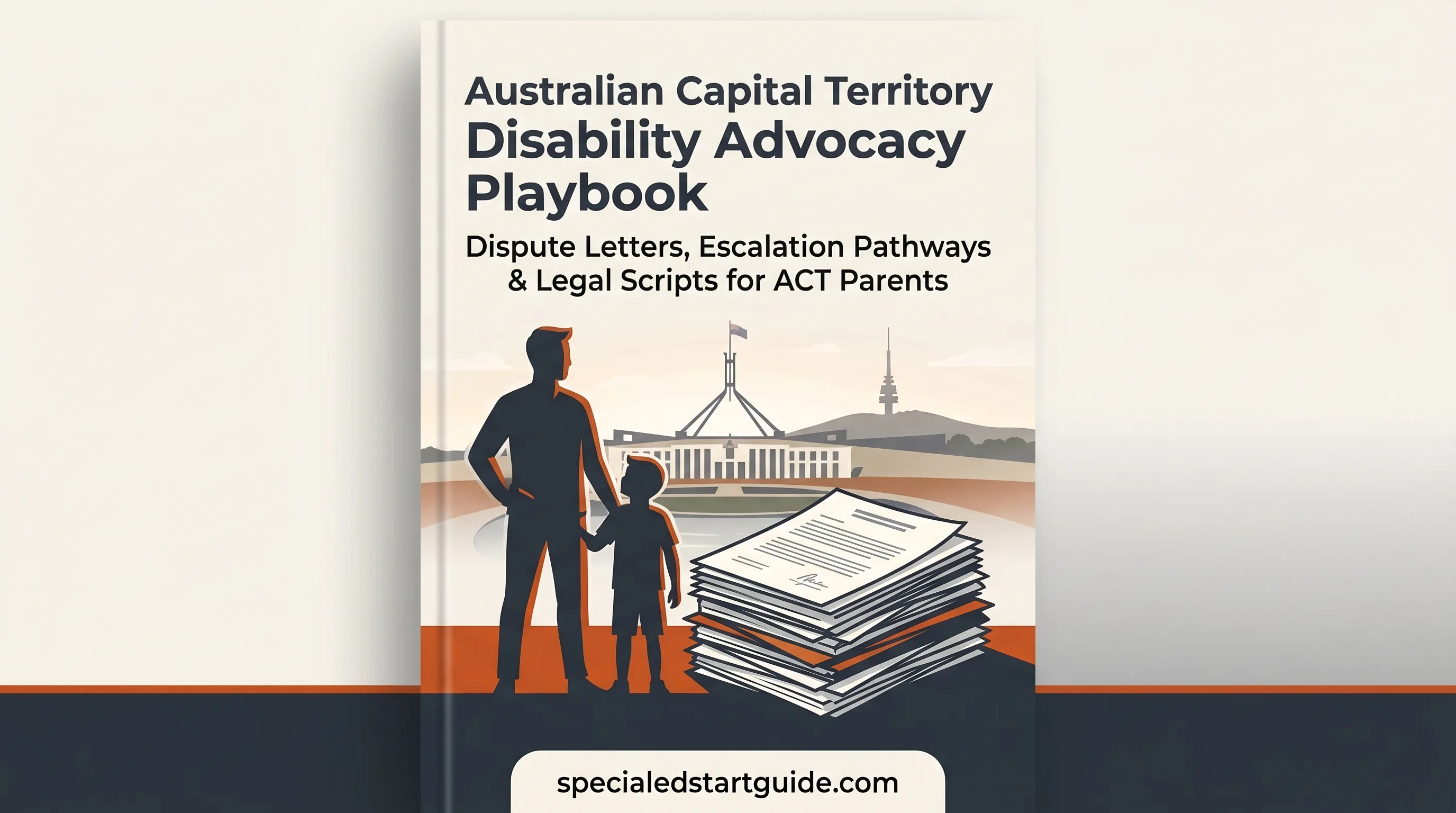
The ACT Disability Advocacy Playbook is the structured dispute-resolution system that gives you what the Directorate's website leaves out: the exact letters to send, the specific legislation to cite, and the step-by-step escalation pathway from classroom teacher to the ACT Civil and Administrative Tribunal. Every template names the specific ACT institution, cites the specific federal or territory law, and tells you exactly who to contact and what to include.
What's Inside the Playbook
The ACT Dispute Resolution Framework
Three layers of law protect your child — the Disability Discrimination Act 1992, the Disability Standards for Education 2005, and the ACT Human Rights Act 2004 (Section 27A). When the school says "we can't do that," you need to know which layer they are violating and which obligation they are failing to meet. This section translates all three into the specific provisions you cite in correspondence — not arguments about feelings, but references to binding legal duties.
Copy-Paste Advocacy Letter Templates
Twelve dispute letters covering the situations ACT parents face most often: demanding implementation of assessment recommendations, documenting a verbal refusal in writing, challenging an "unjustifiable hardship" claim, requesting NCCD funding transparency, escalating to the Education Directorate, filing with the ACT Human Rights Commission under the Discrimination Act 1991, and more. Fill in the bracketed details. Send it tonight. The paper trail that wins complaints starts with the first email.
The Four-Level Escalation Ladder
When the school says no and means it, you need to know exactly who to contact next — and in what order. This section maps the full ACT complaints pathway for all three school sectors: ACT Public Schools through the Directorate's Enquiries and Complaints unit, Catholic schools through the Catholic Education Archdiocese of Canberra and Goulburn (CECG), and Independent schools through AISACT. Each step includes who to contact, what to include, expected response times, and when to escalate further — all the way to the ACT Human Rights Commission and the ACT Civil and Administrative Tribunal.
NDIS-School Coordination Scripts
Your child's NDIS therapist needs classroom access. The school says no. This section gives you the policy-backed language that dismantles the "we don't do that here" objection — the distinction between educational adjustments (school's responsibility under the DSE 2005) and functional supports (NDIS-funded), the AISACT guidelines for external providers, and the formal correspondence template that forces the school to coordinate.
The NCCD Funding Accountability Tool
The school is claiming federal NCCD disability loading for your child's support. That funding has conditions — the school must provide documented adjustments for a minimum of 10 weeks. Most parents do not know this. This section gives you the exact question to ask: "What NCCD category and adjustment level are you recording for my child, and where is the 10-week evidence of adjustments being delivered?" Schools respond very differently when a parent understands the funding mechanism.
Discipline and Suspension Advocacy
If your child is being suspended for behaviour directly related to their disability — meltdowns, task refusal, social conflicts — without a Functional Behaviour Assessment, the school may be engaging in disability discrimination. This section gives you the legal framework and the specific letter templates to challenge punitive responses that treat disability-related behaviour as a conduct issue.
Who This Playbook Is For
- Parents whose child's ILP is not being implemented — the school wrote goals and agreed to adjustments, but nothing has changed in the classroom
- Parents who paid thousands for a private psychoeducational assessment and the school has not acted on a single recommendation
- Parents whose NDIS-funded therapist has been denied classroom access and neither the school nor the NDIS will take responsibility
- Parents whose child is being suspended for disability-related behaviour without a Functional Behaviour Assessment or ILP revision
- Parents who want to file a complaint with the Education Directorate or the ACT Human Rights Commission but do not know what to write or what legislation to cite
- Parents at Catholic or independent schools who have been told government disability policies "don't apply" — the DDA 1992 and DSE 2005 apply to every school in Australia without exception
- Parents who moved to the ACT from interstate or overseas and discovered the territory does not recognise their child's existing support plan
- Parents who have tried every informal approach and need the formal, legally grounded escalation steps
Why Not Just Use the Free Resources?
The free resources are valuable. They are also structurally unable to help you in the moment you need help most.
- The Education Directorate tells you the rules. This Playbook gives you the letters to send when the school breaks them — citing the specific ACT legislation the school is violating, addressed to the specific official who is obligated to respond.
- Advocacy for Inclusion triages the most urgent cases in the territory. If your child is struggling but not in immediate crisis, you face an indefinite waitlist. This Playbook is the advocate in your inbox at 10 PM the night before you need to send a complaint.
- National advocacy guides cover federal law broadly. They say "contact your state education department." This Playbook names the Directorate's Enquiries and Complaints unit, the ACT Human Rights Commission, the CECG central office, AISACT, and the ACT Ombudsman — with phone numbers, filing procedures, and what to include at each step.
- Etsy and TPT sell US IEP advocacy templates. They reference IDEA, Section 504, and IEP teams. None of these exist in the ACT. Citing US legislation in an Australian school signals that you do not understand the system — and instantly diminishes your credibility.
Free resources explain what the law says. This Playbook gives you the letters that make the school obey it.
— Less Than 10 Minutes With a Private Disability Advocate
A private disability advocate in Canberra charges $100 to $190 per hour. A specialist education lawyer charges $370 for an initial consultation alone. You have likely already spent $2,000 to $3,000 on assessments the school is currently ignoring. This Playbook costs a fraction of those fees — and gives you the documented advocacy system to force the school to act on those assessments instead of filing them away.
Your download includes 7 PDFs:
- Complete Advocacy Guide — 12 chapters covering ACT legal frameworks, the dispute resolution hierarchy, ILP accountability tactics, NCCD funding accountability, advocacy letter strategy, NDIS-school coordination, discipline and suspension advocacy, building your evidence file, working with advocates and lawyers, the full escalation pathway, and key contacts
- Advocacy Letter Templates — all 7 copy-paste dispute letters as a standalone printable: assessment requests, NCCD information requests, reasonable adjustment demands, Directorate complaint escalations, FOI requests, NDIS-school coordination letters, and the communication log
- Escalation Pathway — the four-level complaints ladder from classroom teacher to ACAT, with contacts, deadlines, and the 60-day ACAT referral warning, formatted as a fridge-sheet reference card
- Key Contacts & Resources — every ACT phone number, email, and website you need on a single printable page: Education Directorate, Human Rights Commission, Advocacy for Inclusion, Legal Aid ACT, BSSS, assessment clinics, and key legislation
- Evidence File & Progress Tracker — fillable worksheets for organising your evidence file, tracking ILP goal progress across all four terms, and monitoring whether agreed adjustments are actually being implemented
- NDIS-School Boundary Guide — the who-pays-for-what reference table, grey area response scripts, therapist access requirements, and information-sharing agreement checklist to bring to SSG meetings
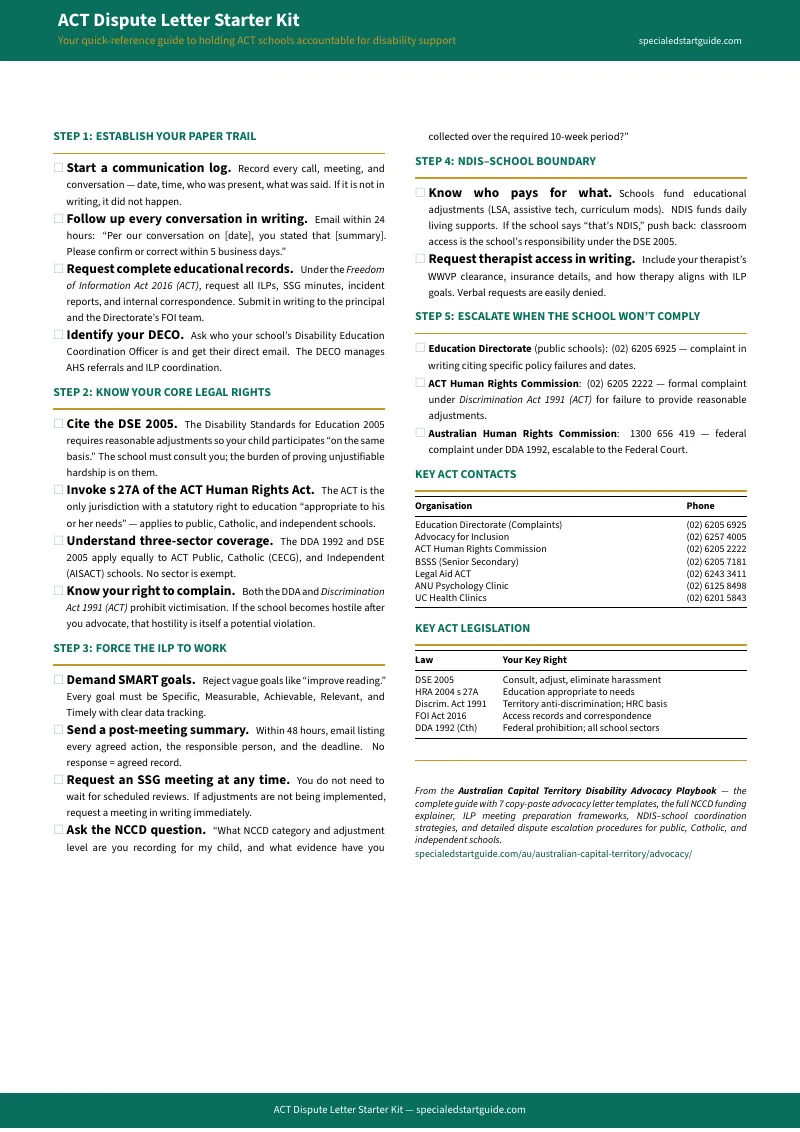
- ACT Dispute Letter Starter Kit — the quick-reference checklist with paper trail protocols, core legal rights with DDA 1992, DSE 2005, and ACT Human Rights Act 2004 citations, ILP accountability steps, NDIS-school boundary scripts, escalation contacts, and the NCCD funding question every parent should ask
Instant PDF download. Send your first dispute letter tonight. File your first complaint this week.
Money-back guarantee, no time limit. If the Playbook does not change how you handle your child's disability education disputes, email us for a full refund. No questions asked.
Not ready for the full Playbook? Download the free ACT Dispute Letter Starter Kit — a quick-reference guide with the paper trail checklist, core legal rights, key contacts, and the NCCD funding question that forces transparency. It is enough to send your first documented follow-up email tonight, and it is free.
Every day without a documented paper trail is a day the school claims compliance. Your child's next dispute does not have to be fought alone.